

Aldo Manutius: ten interludes
Virtual exhibition of ten Aldine editions from the Biblioteca Nazionale Marciana
Aldus Manutius (Bassiano 1449/1452–Venice 1515) was the originator of the modern concept of the publisher. Before him, printing had seen a succession of numerous printers, some highly skilled and innovative; however, the scope, ethical dimension, and network of collaborators that characterised the programme he developed over twenty years of activity in his workshop—from his debut in 1495 with Constantine Lascaris’s Erotemata to Lucretius’s De rerum natura of January 1515, issued shortly before his death on 6 February of the same year—were entirely unprecedented and were immediately recognised as such by his contemporaries.
Aldine marciane, Venice, Biblioteca Nazionale Marciana, 2015.
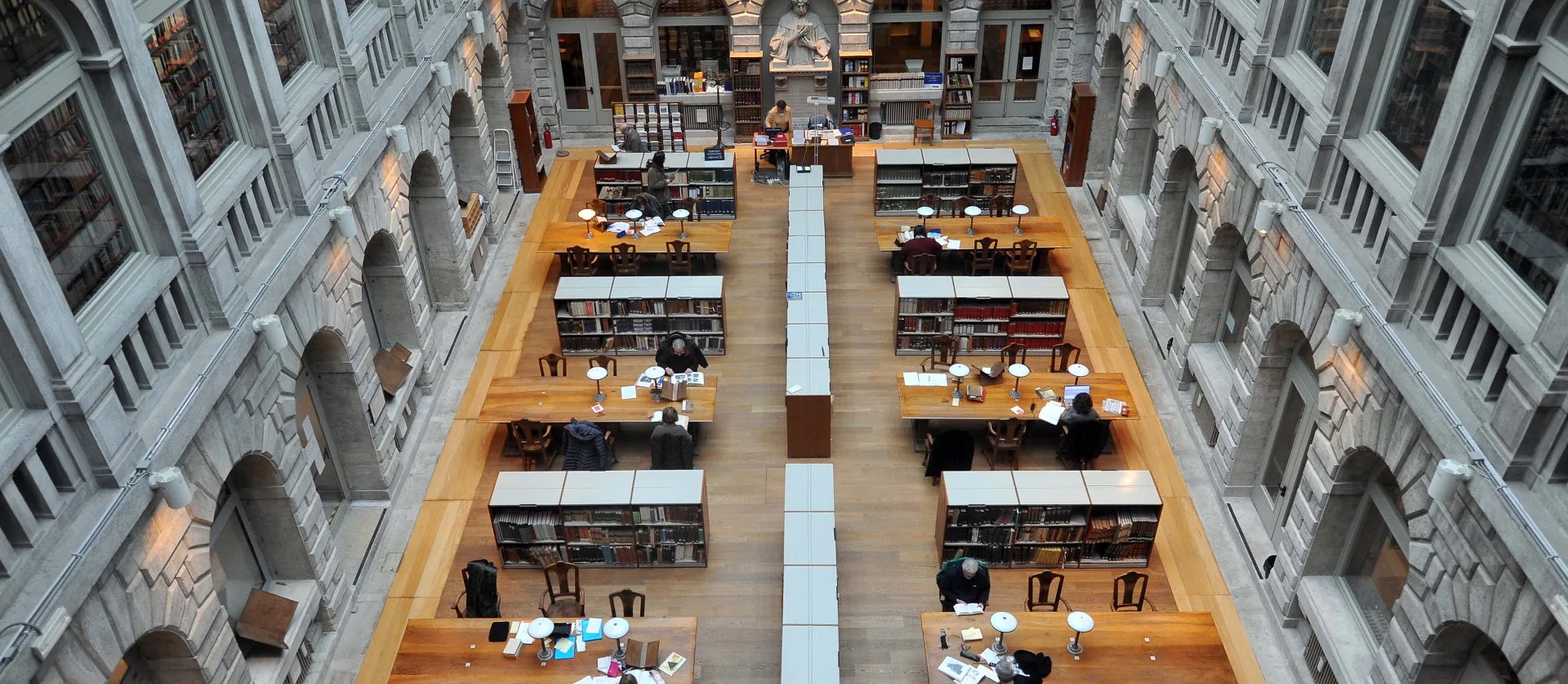
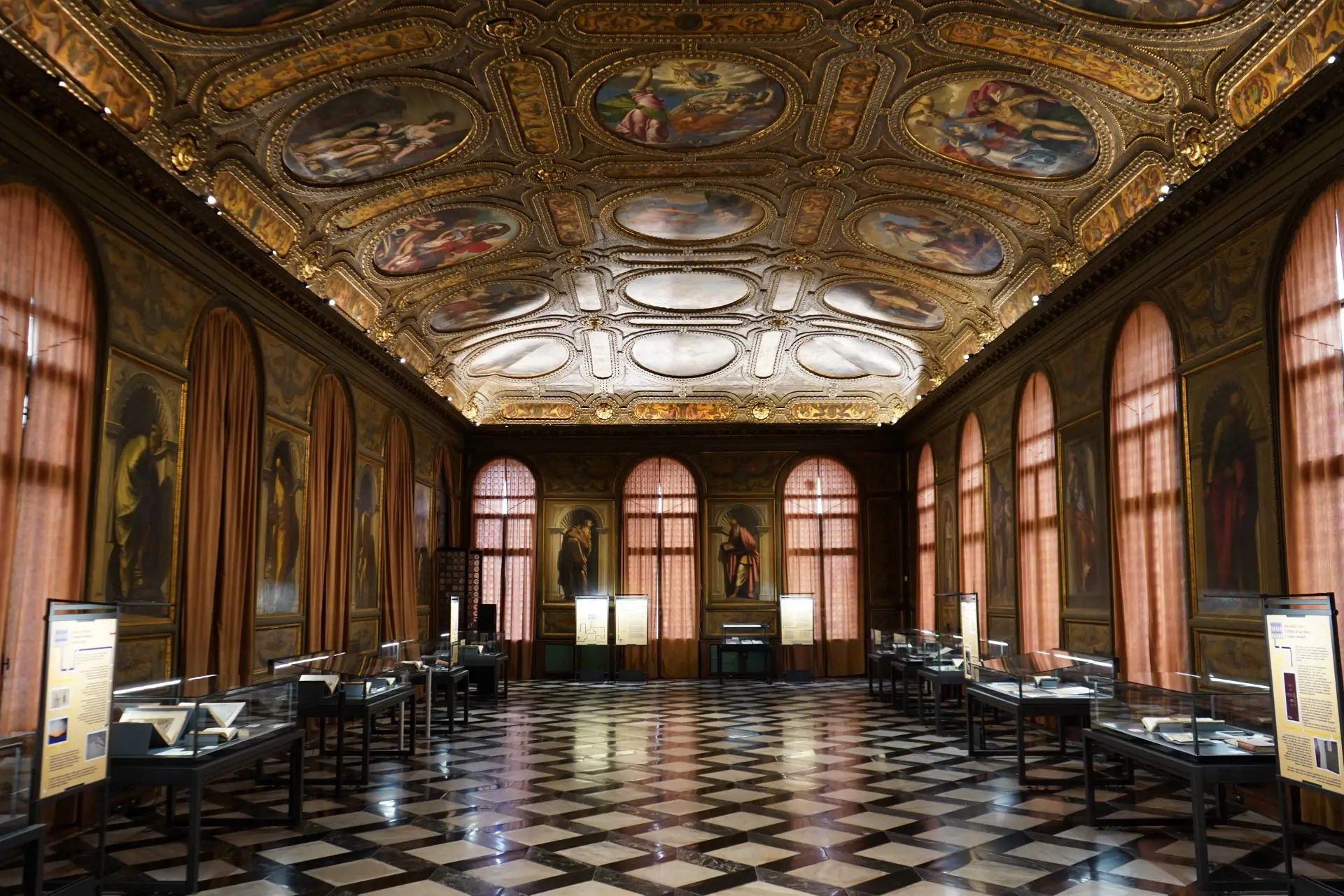
To conclude the extensive tribute that the Marciana has devoted to the great Renaissance publisher—through whom Venice, already the capital of the printed book, became a shining example of innovation and genius—the Library offers, through this virtual exhibition, a small but significant selection from its collections: 130 editions were produced by Aldus’ press in partnership with Andrea Torresano; of these, the Marciana holds no fewer than 107, represented by 156 copies.
For the occasion, ten Aldine editions have been selected and illustrated, presented in chronological order of printing. The commentary focuses on the authors of the texts, on Aldus’ contribution to their specific editorial and typographical realisation, and finally on the history of the Marciana’s copies, with useful references to the provenance archive available on the Library’s website. The short-title description includes a link to the detailed OPAC record. Visitors will also be able to browse the ten Aldine editions in their entirety.
The exhibition was curated by Tiziana Plebani; the web presentation was created by Donatella Benazzi with the support of Bazzmann Srl; the catalogue entries were prepared by Orsola Braides, Saida Bullo, Elisabetta Lugato, Susy Marcon, Maria Grazia Negri, Tiziana Plebani, and Elisabetta Sciarra; the photographic reproductions were taken by Paolo Emilio Pizzul, while others are drawn from the Marciana’s collections.
Aldus Manutius, Institutiones grammaticae, Venice, Andrea Torresano, 1493.
In the Institutiones grammaticae, Aldus Manutius distilled the experience he had accumulated over his long career as a teacher, as he recounts in the dedicatory letter to Alberto Pio di Carpi with which the book opens, recalling the six years or more during which he taught him and his brother with “summa fide curaque”. He explains that he arrived at this work after composing fragmenta, that is, exercises on Greek and Latin grammar and other works useful for study, which he hoped soon to publish in revised form. Aldus’ Greek grammar, however, would appear only posthumously, in November 1515, edited by Marcus Musurus. The Institutiones were not, however, the first of Manutius’ works to be printed: between 1489 and 1490 the short poem Musarum Panegyris, dedicated to Caterina Pico and in which Aldus set out his teaching methods in verse, had been printed in Venice by Battista de Tortis. This afforded him the opportunity to become acquainted with the Venetian printing milieu and to establish the most important relationship of his publishing career, that with the printer and bookseller Andrea Torresano, from whose press, as scholarship now confirms, the Institutiones emerged in March 1493, as indicated by the colophon: “Impressae Venetiis summa diligentia, septimo Idus Martias MCCCCXCIII”.
While in the dedication—in which he still signed himself Aldus Manucius Bassianas—he stated that he had decided to publish the work in response to repeated requests, at the end of the text he specifies that he was motivated by the need to remedy the poor quality of the teaching materials then in use, which were ineffective and burdensome for students (fol. 89r). The opening section of the grammar, which presents prayers from the Psalter alongside the letters of the alphabet, the division into vowels and consonants, and syllabification, shows how, for Aldus, education was closely linked to religious instruction and the cultivation of proper conduct.
Only the Marciana copy of this edition is known to survive. It entered the Library in 1952 as a gift from the Italian Ministry of Public Instruction, after having been discovered in the Library of the Seminary of Foligno by Camillo Scaccia Scarafoni. It had previously belonged to the collection of the Foligno scholar Lodovico Jacobilli and was initially assigned to the Biblioteca Nazionale Centrale in Rome.
The copy is, to date, the only surviving witness of the first edition of Aldus’ Latin grammar and lacks four leaves (fols. a3–6). It is also of particular importance for the numerous autograph annotations by Aldus Manutius, which make it possible to trace the process of critical revision initiated after publication in preparation for a second edition. In the margins he added to, supplemented (including insertions in Greek), and corrected (with some erasures) the text in several places, as can be seen by comparing these passages with the 1501 edition and subsequent printings.
On fol. f8v (= 44v) there is an ownership note: “huic libro studui ego qui noncupor Ioan Maria Pecci florianensis”, dating from the late sixteenth century.
The binding, re-covered in leather, dates from the twentieth century.
Reference bibliography:
- John Bateman, Aldus Manutius’ Fragmenta Grammatica, “Illinois Classical Studies”, 1 (1976), pp. 226–261
- Filippomaria Pontani, Preghiere, parafrasi e grammatiche: il Credo e L’Ave Maria di Marco Musuro, “Bibliothèque d’Humanisme et Renaissance”, 76 (2014), pp. 325–340
- Matteo Venier, Nota Manuziana, “Lettere Italiane”, 56 (2004), no. 4, pp. 618–653
Tiziana Plebani
Pietro Bembo, De Aetna dialogus, Venice, Aldo Manutius, 1495
The first edition of Pietro Bembo’s (1470–1547) De Aetna—likely financed by the Bembo family and of particular importance for the Aldine press—appeared in February 1496 (the date is given more veneto).
The booklet, consisting of just thirty leaves, is dedicated to his friend Angelo Gabriele, Bembo’s fellow student in Messina and Padua. It is in fact a minor work from a literary point of view: it recounts, in the form of a dialogue between Pietro and his father Bernardo, Bembo’s journey to Sicily, where he had gone to learn Greek, and focuses in particular on the ascent of Mount Etna; the dialogue serves as a pretext for a series of learned quotations from Latin and Greek classical authors.
This is Aldus’ first Latin edition, and for it the Roman typeface—later known as “Bembo” (R4: 114)—was used for the first time. It was cut by Francesco Griffo, and it is thought that the scribe Bartolomeo Sanvito, or another of the professional copyists working for Bernardo Bembo’s library, was involved in its design.
Most copies of this Aldine edition display a further characteristic, which is also present in both Marciana copies: a number of handwritten corrections appear between the lines. These consist partly of simple corrections of misprints and partly of authorial variants. The second Marciana copy (Aldine 380) contains only one such intervention, on fol. A2r, l. 8, which is, moreover, a simple typographical error.
The printing was in fact certainly carried out under the author’s close supervision; it is clear that—whether to correct final misprints or to reflect changes of mind—the copies already produced were systematically amended by hand. The subsequent edition of the work, dated 1530 and published by Giovanni Antonio Nicolini da Sabbio while Bembo was still alive, incorporates almost all of these corrections.
Two copies preserved at the University Library, Cambridge, and at the Biblioteca Estense in Modena bear the same corrections, which have been attributed to the hand of Pietro Bembo himself.
This particular feature of the edition thus sheds light on printing and typesetting practices in Aldus’ workshop and on the relationship between Manutius and the authors whose works he published.
Reference bibliography:
- Curt Ferdinand Bühler, Manuscript Corrections in the Aldine Edition of Bembo’s De Aetna, “Papers of the Bibliographical Society of America”, 45 (1951), pp. 136–142
- Elisa Curti, Entry I.12, in Pietro Bembo e l’invenzione del Rinascimento, ed. Guido Beltramini, Davide Gasparotto, Adolfo Tura, exhibition catalogue (Padua, Palazzo del Monte di Pietà, 2 February – 19 May 2013), Venice, Marsilio, 2013, pp. 106–109
- Bianca Maria Mariano, Il De Aetna di Bembo e le varianti dell’edizione del 1530, “Aevum”, 65 (1991), no. 3, pp. 441–452
Elisabetta Sciarra
Alessandro Benedetti, Diaria de bello Carolino, Venice, Aldus Manutius, [after 27 August 1496]
Alessandro Benedetti, author of De bello Carolino, was born in Legnago around 1450 and died in Venice in 1512. He studied at the University of Padua and, from 1490, held the chair of practical medicine and anatomy in the same city. The author of medical works of considerable importance, published and studied both in Italy and beyond the Alps, he is regarded as the founder of the Paduan School of Anatomy: he was responsible for the construction of the first dismantlable anatomical theatre and for extending the practice of autopsy—previously reserved for the bodies of the executed—to those of the sick. In 1495 he was appointed chief physician to the army of the League formed between Venice, Ludovico il Moro, the Pope, and Spain to oppose Charles VIII’s expedition into Italy. He personally witnessed the events of the Battle of Fornovo and the subsequent siege of Novara. During this campaign he composed this brief account, almost certainly commissioned by the Venetian authorities, as is evident from the letter to Sebastiano Badoer and Girolamo Bernardo printed at the end of the pamphlet.
In an elegant humanistic rhetorical style, Benedetti gives direct voice to the protagonists of the narrative, including Ludovico Sforza and Charles VIII, going so far as to confer a certain dignity upon the latter despite his defeat.
The tone of the work is propagandistic: the author seeks to exalt the Venetian military contribution, transforming the uncertain outcome of the battle into a clear victory for the League.
Nevertheless, it ranks among the principal sources for this important event, describing in detail the plundering of the French baggage, the horrors of the battlefield strewn with the dead, and the French retreat to Asti. It is an indispensable source for the section concerning the siege of Novara.
The work was first translated into Italian by Ludovico Domenichi and published in Venice by Gabriel Giolito de’ Ferrari in 1549.
In Renouard the edition is listed among the undated ones, but the dedication at the end reads: “Venetiis M.IIIID. Sexto Cal. Septembres”. The attribution to Aldus’ press is based on typographical features linking it to the contemporary edition of Pietro Bembo’s De Aetna. Until 1496 Aldus had published only Greek classics, with the exception of Bembo’s short Latin work already mentioned. This therefore represents a new development in his editorial policy, reflecting an interest in contemporary history shared by Aldus himself and his readers.
The text underwent numerous corrections during the printing process. In the Marciana copy, alongside printed corrections of obvious errors, there are numerous handwritten corrections—shared with many other copies and made by the same hand—which were introduced in the printing workshop prior to publication.
The Marciana copy, from the bequest of Girolamo Ascanio Molin (shelfmark vol. 212), is preserved in an eighteenth-century leather binding over boards. The covers feature a double blind-tooled fillet along the edges. The spine, divided into five compartments, is decorated with a green leather label bearing the author’s name, title, and imprint stamped in gold. The endpapers are of marbled paper.
Reference bibliography:
- Alessandro Benedetti, Diaria de Bello Carolino, edited with introduction, translation, and notes by Dorothy M. Schullian, New York, Frederick Ungar, 1967
- Mario Crespi, “Benedetti, Alessandro”, in Dizionario Biografico degli Italiani, 8 (1966), Rome, Istituto dell’Enciclopedia Italiana, pp. 244–247
- Tiziana Pesenti, Professori e promotori di medicina nello Studio di Padova dal 1405 al 1509: repertorio bio-bibliografico, Trieste, LINT, 1984, pp. 48–52
Maria Grazia Negri
Aristotle, Opera, Venice, Aldus Manutius, 1495–1498
The editio princeps of the complete works of Aristotle (384–322 BC), in five volumes published between 1495 and 1498, comprises the Aristotelian corpus—with the exception of the Poetics and the Rhetoric—as well as that of Theophrastus, excluding the Characters. This is the first complete work to emerge from Aldus Manutius’s press. Dedicated to Alberto Pio, Prince of Carpi (1475–1550), the edition reflects Aldus’ cultural programme to publish the philosopher’s text in Greek for the first time, at a moment when the University of Padua was abandoning the Averroist vulgate in favour of the original text, explained for the first time by Niccolò Leonico Tomeo. The edition was not definitively superseded until the nineteenth century by those of I. Bekker and J. G. Schneider.
Those who collaborated in bringing this monumental edition to light included Alessandro Bondeni, Scipione Forteguerri, Alessandro Cavalli, Thomas Linacre, Gabriele da Brisighella, Giustino Decadio, Niccolò Leoniceno, and Lorenzo Maioli. It is known that at least one codex was produced for use in the printing house: this is the manuscript now held at Harvard University, Houghton Library, Gr. 7. Copied within Manutius’s circle by four scribes, it is the result of transcription from at least six or seven different source manuscripts; however, this codex was certainly not the only exemplar. Studies have shown that other codices were also used, including Par. Suppl. gr. 212 and Par. gr. 1848, now at the Bibliothèque nationale de France, and the manuscript Bern, Burgerbibliothek, Bern. 402. The latter codex, used by Aldus for the text of certain works by Aristotle and for those of Theophrastus, is particularly significant in that it was transcribed by Niccolò Leonico Tomeo himself, who lectured on the Aristotelian corpus in Greek at the University of Padua. The typeface used for printing is Aldus’ first Greek type (Gk1), cut by Francesco Griffo on the model of the handwriting of the professional scribe Immanuel Rhousotas. Some copies were also printed on parchment.
The Marciana copy (Aldine 113–118) is the result of the assembly of volumes from different collections. The first volume (Aldine 113) belonged to the Pavia-born humanist Giovanni Battista Rasario (1517–1578). The second, third, and first part of the fourth volumes (Aldine 114–116) belonged to Gianfrancesco Mussato, whose hand—responsible for numerous marginal annotations—can be identified through palaeographical comparison with autographs preserved in the Library of the Episcopal Seminary in Padua. Gianfrancesco Mussato’s books were seen in the library of Apostolo Zeno by Mussato’s biographer, Abbot Giuseppe Gennari; the three volumes bear handwritten cryptographic notes attributable to Zeno’s ownership. Moreover, as shown by the catalogue of his library (Marc. It. XI, 289–293 [= 7273–7278]), Apostolo Zeno must have owned the entire Aristotelian edition, and not just the three surviving volumes. As is well known, Zeno donated his book collection to the Collegio del Santissimo Rosario alle Zattere, through which most of it entered the Marciana.
The second part of the fourth volume (Aldine 117) belonged to an anonymous annotator, perhaps of transalpine origin; nothing is known about the provenance of the fifth volume (Aldine 118).
The Marciana also holds a second copy of the second part of the fourth volume, formerly owned by Cardinal Mario Marefoschi (Aldine 99); it is therefore reasonable to assume that other copies—at least partial ones—of the edition must also have existed, perhaps dispersed through exchange or the sale of duplicates, since a copy of the first part of the same fourth volume, formerly in the Marciana, is now preserved at the Biblioteca dell’Archiginnasio in Bologna (16. M. I. 17).
Reference bibliography:
- Martin Sicherl, “Handschriftliche Vorlagen der Editio princeps des Aristoteles”, in Griechische Erstausgaben des Aldus Manutius. Druckvorlagen, Stellenwert, kultureller Hintergrund, Paderborn – Munich – Vienna – Zurich, Ferdinand Schöningh, 1997, pp. 31–113
Elisabetta Sciarra
Hypnerotomachia Poliphili, Venice, Aldus Manutius, 1499
The Poliphilo is widely admired and celebrated today, thanks to the close interweaving of text and images across its pages, in a harmonious page design that makes the volume an emblem of the Renaissance. The edition was not a great success on the contemporary market, but its beauty and the mystery that pervades it have made it attractive to later generations. The Poliphilo is enigmatic and hermetic in many respects: in its language, its narrative, the very identification of the author of the text, and the possibility of identifying the designer of the illustrations and the cutters of the woodblocks. Above all, it is striking and unusual that Aldus’ name and the date, “Venetiis mense decembri M.ID. In aedibus Aldi Manutii, accuratissime”, appear only at the foot of the final errata. The opening dedication, unusually unlike Manutius, is by the Veronese Leonardo Grassi, probably the financier, and is addressed to Guidobaldo da Montefeltro, Duke of Urbino. The Roman lower- and uppercase type, the woodcut initials, and the elegance of the page layout nevertheless attest to the authority of an Aldine edition.
La Hypnerotomachia di Poliphilo, cioè pugna d’amore in sogno. Dov’egli mostra, che tutte le cose humane non sono altro che Sogno, et dove narra molt’altre cose degne di cognition (“The Hypnerotomachia of Poliphilo, that is, the struggle of love in a dream, wherein he shows that all human things are nothing but a dream, and wherein he recounts many other things worthy of knowledge”): this is the translation of the title in the corrected reissue published by Aldus’ heirs in 1545, who had retained the ability to print from the same woodblocks, preserved at least for the most part. The narrative unfolds, in two books, along the thread of a love story studded with digressions and varied settings, steeped in quotations, as in Boccaccio’s narrative works—such as the Filocolo, the Ameto, and the Filostrato—or in contemporary novellas, yet shaped by episodes especially dense with obscure meanings, emblematic elements, and hermetic allusions. The places of Love constitute stages along a path of wisdom. The language is a vernacular tinged with Latinisms and Greekisms, in which Venetian inflections have been identified.
Since the eighteenth century, after reading the acrostic formed by the initial letters of the chapters, Francesco Colonna, a Dominican resident in Venice at the church of Santi Giovanni e Paolo, has been proposed as the author of the narrative. There is no shortage of alternative hypotheses—Fra Eliseo da Treviso, or a hypothetical Francesco of the Roman Colonna family—advanced on the basis of numerous verified correspondences within the intricate text and of the extensive antiquarian learning it displays. The author of the text must also have suggested some of the illustrations, which are equally admirable in their execution. Among the possible authors of the designs for the woodcuts, attention has now turned to Benedetto Bordon, or to the highly accomplished Second Master of the Canzoniere Grifo. In any case, the style is close to that of the draughtsman responsible for the borders in the Corvinian manuscript containing the Latin version of Filarete’s treatise on architecture, which in the 1490s was in the convent of Santi Giovanni e Paolo and later entered the Marciana.
The Marciana copy is printed on ordinary paper and is unannotated, apart from a few erased marks on fols. r1r and 2r. The binding was replaced in 1908 with a new one in the Maioli style by the expert artistic binder Vittorio De Toldo.
Reference bibliography:
- Francesco Colonna, Hypnerotomachia Poliphili, critical edition and commentary edited by Giovanni Pozzi and Lucia A. Ciapponi, Padua, Antenore, 1964 (updated 1980)
- Francesco Colonna, Hypnerotomachia Poliphili, with translation and commentary by Marco Ariani and Mino Gabriele, Milan, Adelphi, 2004
Susy Marcon
Catherine of Siena, Epistole deuotissime, Venice, Aldus Manutius, 1500
In February 1495, Girolamo Biondo and Giovanni Battista obtained a privilege to print Catherine’s Epistles, but the edition never appeared. Five years later, the printing was undertaken by Aldus, who obtained several copies of the text in order to provide the press with a correct version. The receipt for the loan of these volumes, dated 17 April 1499, survives in autograph form (Marc. It. XI, 207, as the fifth section following four other fragments acquired from various sources in the late nineteenth century). The document records how Aldus obtained—on behalf of Margherita, widow of Peter Ugleimer, and through Antonio Condulmer, in exchange for a pledge and the promise of ten copies of the forthcoming edition—the loan of four manuscripts and one printed volume containing the Epistles from a Venetian monastery, probably Dominican. In Venice, the Dominicans—particularly at the Mantellate convent of Corpus Domini and at the major convent of Santi Giovanni e Paolo—maintained the cult of Catherine, which had taken root in the lagoon as early as the first half of the fifteenth century, even before her canonisation, thanks to the apostolate of the Sienese Tommaso d’Antonio Caffarini. Having obtained a ten-year privilege from the Venetian Senate (dated 23 July 1500), Aldus Manutius completed the printing of the vernacular text of the Epistles on 15 September 1500, in the version edited by Fra Bartolomeo Alzano. Once printing was complete, Aldus prefixed the text with his own introduction, both thoughtful and devout, addressed to Cardinal Francesco Piccolomini, nephew of the future Pope Pius II, and dated 19 September.
The same taste for classical sobriety in subject and carving links the full-page woodcut of Saint Catherine standing (fol. 10v) to the pages of the Poliphilo and to other Venetian illustrations, such as the figures derived from designs by Benedetto Bordon in the Regulae monasticorum, printed by Lucantonio Giunta in April 1500. The compositional skill of Aldus’ printers made it possible to incorporate within the pictorial space a number of typographical inserts bearing mottos associated with the saint, among which one can identify the first appearance of italic type, anticipating what would become the defining typeface of the Aldine enchiridia in subsequent years. The woodcut, unsigned, presents a humanistic version of the saint’s established iconography, as seen in earlier Venetian representations. Saint Catherine of Siena is shown wearing the Dominican habit and characterised by the attributes of the heart, the crucifix accompanied by lilies, a palm branch, and a book, with the triple crown borne aloft by two angels. Compared with the figure on the title page of the Epistles printed in Bologna by Fontanesi in 1492, Catherine has lost her iconographic association with the Virgin of Mercy. The Bolognese volume contained only 31 letters, compared to the 368 included in the Aldine edition.
Two copies are preserved in the Library. The Aldine copy (Aldine 36), formerly owned by Apostolo Zeno, entered the collections of the Collegio del Santissimo Rosario before passing to the Marciana; it originally had a limp parchment binding, now preserved separately. The copy from the collection of Girolamo Ascanio Molin (shelfmark 387 D 23) is missing the leaf containing the woodcut.
Reference bibliography:
- Henri D. Saffrey, Les images populaires des saints dominicains à Venise au XVe siècle et l’édition par Alde Manuce des “Epistole” de sainte Catherine de Sienne, “Italia medievale e umanistica”, XXV (1982), pp. 241–312
- Ennio Sandal, Note di bibliografia cateriniana a margine della edizione aldina delle Epistole, “Miscellanea marciana”, XIII (1998), pp. 171–183
Susy Marcon
Francesco Petrarca, Le cose volgari, Venice, Aldus Manutius, 1501
In the colophon of the edition of Petrarch’s Le cose volgari, Aldus Manutius states that it was produced “with the utmost diligence from the poet’s own handwritten manuscript, obtained from Messer Pietro Bembo”, thereby emphasising the authority of the manuscript source and the prestige of the scholar who had collaborated in editing the text; he adds, with regard to the copies printed on parchment, “revised and approved by him wherever necessary”.
The Aldine edition, which brings together Petrarch’s (1304–1374) Canzoniere and Trionfi, edited by Bembo, immediately provoked expressions of disagreement, if not dissatisfaction, such that Bembo himself was led to explain and defend his work through Manutius’s words in the lengthy dedication “Aldo a gli lettori” (“Aldo to the readers”), placed in the final quire and thus added while the work was already in press. There we read: “I believed myself to have sufficiently guaranteed the correctness of this book […] there are some who say that this version I have given you is not therefore so thoroughly corrected”. Petrarch’s autograph manuscript (now Vat. Lat. 3195) did not include the text of the Trionfi, but it was certainly consulted by Bembo in the preparation of his own autograph (now Vat. Lat. 3197), which was then used for the Aldine edition. Bembo departed from Petrarch’s autograph chiefly in the regularisation of Latinising spellings, truncations, and elisions; nevertheless, his work served as a model of formal and linguistic style for centuries.
The Canzoniere was the first work in the vernacular to be printed in the elegant italic typeface (I1:80) cut by the Bolognese Francesco Griffo, already used by Manutius for Virgil’s works in April 1501, but first appearing to mark the words “iesu dolce / iesu amore” in the woodcut depicting Saint Catherine in the Epistole devotissime published in 1500.
This copy in the Marciana Library belonged to Camillo Capilupi of Grado (1504–1547), who was briefly a pupil of Aulo Giano Parrasio in Rome and later an adviser to Isabella d’Este, Duchess of Mantua, as well as private secretary to Francesco II Gonzaga. Capilupi marked the copy three times with his ownership note (fols. a1r, A7v, and the second rear flyleaf), added several personal notes on court life and on the city of Mantua (flyleaves and pastedowns), and above all annotated various readings in the Trionfo d’amore and the Trionfo della morte. Capilupi probably collated the Aldine edition against the manuscript containing only the Trionfi belonging to the family collection, which remained largely intact until the 1930s, when the Ministry of National Education acquired a substantial part of it, assigning the manuscripts to the Biblioteca Nazionale Centrale in Rome and distributing the printed books among various state libraries. The Marciana was assigned the Aldine Petrarch on 13 June 1932.
Reference bibliography:
- Juan Andrés, Catalogo de’ codici manoscritti della famiglia Capilupi, Mantua, Società all’Apollo, 1797, p. 57
- Giuseppe Frasso, “Appunti sul ‘Petrarca aldino’ del 1501”, in Vestigia. Studi in onore di Giuseppe Billanovich, Rome, Edizioni di storia e letteratura, 1984, pp. 315–336
- Sandra Giarin, Petrarca e Bembo: l’edizione aldina del ‘Canzoniere’, “Studi di filologia italiana”, 62 (2004), pp. 161–193
- Sara Cirasola, La Biblioteca della famiglia Capilupi di Mantova: un tentativo di ricostruzione, “Culture del Testo e del Documento”, 10, no. 30 (Sept.–Dec. 2009), pp. 103–145
Orsola Braides
Dante Alighieri, Le terze rime, Venice, Aldus Manutius, 1502
With Le terze rime, the long collaboration between Aldus Manutius and Pietro Bembo continued, a partnership that had begun with the first edition issued by the Aldine press, Constantine Lascaris’ Erotemata. This collaboration was further strengthened by the enchiridion project, a series of octavo volumes devoted to major works of Latin and Italian literature and printed in italic type. After editing Petrarch’s vernacular texts, published in July 1501, Bembo turned to Dante’s great masterpiece, thanks to his access to a most valuable source: the manuscript of the Commedia donated by Boccaccio to Petrarch and preserved in the rich library of his father Bernardo. From this codex (now widely identified as Vat. Lat. 3199, later owned by Fulvio Orsini), copied by a scribe in Florence around the mid-fourteenth century and acquired by Petrarch between 1351 and 1353, Pietro Bembo prepared a copy in his own hand (now Vat. Lat. 3197) during a stay at Ercole Strozzi’s villa near Ferrara, from 6 July 1501 to 26 July 1502. With this edition, Bembo introduced a decisive break with the established tradition of printing the Commedia, beginning with the title Le terze rime and, even more significantly, with the decision—certainly shared by Aldus—to dispense with Cristoforo Landino’s commentary, which had been regarded as an indispensable companion to Dante’s text since the first Florentine edition of 1481. Dante’s text was thus restored to its narrative function and its capacity to engage the reader, thanks to the pocket format, the layout with wide margins, and above all the removal of the historical-philological apparatus and interpretative commentary. This restoration was further enabled by Bembo’s interventions in punctuation, spelling, and accentuation. He eliminated abbreviations and, above all, reshaped the text so as to restore its original fourteenth-century character. This was therefore a radical undertaking, assumed by Bembo with full responsibility, which Aldus acknowledged by refraining—contrary to his usual practice—from including dedications or prefaces. This deliberate break with tradition immediately met with strong opposition, particularly in Florence, as is evident from comparison with the Giuntine edition of 1506; nevertheless, Bembo’s version of the Commedia prevailed, advancing the reform of the vernacular and winning over readers through the elegance of the edition.
On the verso of the first leaf, Aldus inserted the explanatory subtitle: “Lo ‘nferno e ‘l Purgatorio e ‘l Paradiso di Dante Alaghieri”.
In the Marciana copy, which has an elegant red leather binding with marbled endpapers and pastedowns in a peacock pattern and gilt, gauffered edges dating from the late nineteenth or early twentieth century, the final leaf has been torn, resulting in the loss of part of the text and most of the colophon.
This copy belongs to the variant lacking a printer’s device on the verso of the final leaf.
On the verso of the first leaf there is a handwritten note, possibly by a former owner: “Brunaccione”; in several places in the margins, a hand (sixteenth century?) has drawn manicules and added other marks highlighting passages and individual words.
Reference bibliography:
- Leonella Coglievina, Lettori della Commedia: le stampe,in «Per correr miglior acque…»: bilanci e prospettive degli studi danteschi alle soglie del nuovo millennio, I–II, proceedings of the international conference (Verona–Ravenna, 25–29 October 1999), Rome, Salerno Editrice, 2001, vol. 1, pp. 325–370
- Massimo Danzi, La biblioteca del cardinal Pietro Bembo, Geneva, Droz, 2005
- Angelo Eugenio Mecca, La tradizione a stampa della “Commedia”: dall’aldina del Bembo (1502) all’edizione della Crusca (1595), “Nuova Rivista di letteratura Italiana”, XVI, 1–2 (2013), pp. 9–59
- Fabio Romanini, Manoscritti e postillati dell’«antica vulgata»,in Nuove prospettive sulla tradizione della «Commedia». Una guida filologico-linguistica al poema dantesco, edited by di Paolo Trovato, Florence, Franco Cesati, 2007, pp. 59–60
Tiziana Plebani
Athenaeus of Naucratis, Δειπνοσοφισταί (Deipnosophists), Venice, Aldus Manutius and Andrea Torresano, 1514.
Athenaeus (2nd–3rd century AD), a Greek writer from Naucratis in Egypt, is the author of the Deipnosophisti, or Dotti a banchetto (The Learned Banqueters), composed between 193 and 197 and established as an extraordinary source for the study of Greek culture. The symposium framework adopted by the compiler provides the large group of learned dinner guests with an opportunity to display encyclopaedic erudition, preserving a wealth of literary, historiographical, and historical information through which traces of authors and works of Hellenic civilisation that would otherwise have been lost have survived.
The publication of the Greek text had long been in preparation within Aldus’ editorial programme, as attested by a proof dated to the beginning of 1498, of which a single copy survives in the Pierpont Morgan Library in New York (ISTC ia01175000). However, the editio princeps of Athenaeus, edited by Marcus Musurus (c. 1475–1517), did not appear from the Aldine press until August 1514, together with Hesychius’ Lexicon: these were the last two Greek authors to crown the printer’s twenty-year enterprise.
Athenaeus’s work in fifteen books survives in the plenior version in a tenth-century manuscript that has come down to us in mutilated form, Marc. gr. Z. 447 (= 820). In order to restore the Greek text, the Cretan Marcus Musurus, editor and collaborator in the Aldine workshop, used an apograph of the Marcian codex, supplementing the missing books (the first two and part of the third) with an epitome, as Aldus himself states in the dedicatory epistle on fol. A1v.
Manutius dedicated the edition to Janos Vértesy, a Hungarian humanist who studied in Venice under the renowned philologist Musurus. On the title page, on fol. A1r, the Latin title—ATHENAEVS—is followed by a summary in Greek cursive, elegantly arranged in two pyramids so as to form a sort of hourglass; below, the celebrated device of the press, with the anchor, the dolphin, and the inscription “Aldus M.R”, within a double fillet frame (Fletch. f4; A3c.), completes the balanced composition of the page. The folio edition, set in Greek (Gk3:90), italic (I1:80), and Roman (R6) types, presents a careful and skilful typographical design, in which measured forms and the art of printing bear witness to the originality of the Aldine product.
On the title page, the Marciana copy bears an ownership inscription, harmoniously entered in a steady hand in the space between the extensive summary compiled by Musurus and Aldus’ printer’s device; the annotation, repeated identically in the colophon, reads: “Collegij Societatis Jesu Heiligenstadij A° 1595”, attesting to the use of this book in the late sixteenth century at the Jesuit seminary in Heiligenstadt, in central Germany.
In the lower right-hand corner of the title page, another brief ownership note is visible: “Jo. Grammii”, in the hand of the Danish bibliophile and librarian Hans Gram (1685–1748), whose collection of some 24,000 books, auctioned after his death, was dispersed among various public and private collections.
This copy, in an eighteenth-century stiff parchment binding, preserves on the front pastedown the eighteenth-century San Marco ex libris engraved by Zucchi and two old shelfmarks (CXIV.10; CXIV.8*): these two details make it highly likely that the volume entered the Libreria di San Marco by the end of the eighteenth century.
Reference bibliography:
- Harry George Fletcher, New Aldine Studies: Documentary Essays on the Life and Work of Aldus Manutius, San Francisco, B. M. Rosenthal, 1988
- Anna Lucia Di Lello-Finuoli, Per la storia del testo di Ateneo, “Miscellanea Bibliothecae Apostolicae Vaticanae”, 7, Vatican City, Vatican Apostolic Library, 2000, pp. 129–182
- Luigi Ferreri, Marco Musuro, Turnhout, Brepols, 2014, pp. 179–192
- Benoît Louyest, L’épitomé du Banquet des sophistes d’Athénée, “Rursus”, 8 (2012)
Saida Bullo
Hesychius of Alexandria, Λεξικόν. Dictionarium, Venice, Aldus Manutius and Andrea Torresano, 1514
Editio princeps of the Lexicon of Hesychius (5th cent. AD), the author of the most extensive and important lexicon of classical antiquity, in which over five thousand headwords are arranged in alphabetical order, consisting largely of rare words drawn primarily from poetic and dialectal usage (among his sources are the grammarians Herodian, Aristarchus of Samothrace, Harpocration, Heliodorus, and, above all, Diogenianus of Heraclea). The text, set in two columns, is preceded by Aldus’ dedication to Gian Giacomo Bardellone (1472–1527), a scholar and mathematician active at the court of Mantua, “Graece et Latine doctissimus […] longe peritissimus”, in gratitude for the generosity shown in lending him the manuscript, a codex unicus, “ut daretur imprimendus impressoribus nostris… ut fiat communis studiosis omnibus, etiam posteris”. The manuscript, dating from the third decade of the fifteenth century, is the present-day Marc. Gr. Z. 622 (= 851), which entered the Biblioteca Marciana only in 1734 following a donation by the Venetian patrician Giambattista Recanati (1687–1734).
The edition was prepared by Marcus Musurus, a scholar and Aldus’ collaborator on Greek texts, who intervened directly on the manuscript without producing an apograph, introducing corrections to the alphabetical order of the headwords, to faulty accents and grammatical errors, as well as adding marginal and interlinear explanations. The use of the original manuscript and the numerous corrective interventions—datable to between 1509 and 1514 (Speranzi, 2013)—were in fact the object of considerable criticism.
The decision to print the Dictionarium once again demonstrates Aldus’ concern for the pedagogical dimension of his work: alongside literary texts, from as early as 1495 he was also engaged in publishing tools useful to scholars for the study of the Greek language.
The history of the text itself also bears witness to the development of his printing enterprise and to the progress made over time both in editorial techniques and in the experience of the compositors. By comparing this final printed state with earlier stages, it is possible to observe how Musurus’ numerous and complex corrections were nevertheless accurately executed and consistently reproduced by the compositors (Lowry, 1984).
The printer’s device of the anchor and dolphin corresponds to Fletcher, no. 2.
On the first four folios of each gathering—three in the final one—the author’s name is printed in the lower margin, either in full or, more frequently, abbreviated as “Hesych”. The typeface is Greek italic.
Watermarks: an anchor within a circle (fols. c1, B4), of the Briquet 479 type, with a countermark of letters (fols. a7, b2), and a diadem-shaped crown with a superimposed cross, of the Briquet 4890–4902 type (fols. f3, g7, h6, i2), of Venetian origin.
The Marciana copy, whose provenance within the Library is unknown, shows guide letters for initials that were never executed and an eighteenth-century binding in full stiff parchment, with a label on the spine bearing the author’s name, title, printer, and date stamped in gold; hand-sewn endbands in coloured thread and a green textile bookmark; uncut edges.
Reference bibliography:
- Martin Lowry, Il mondo di Aldo Manuzio: affari e cultura nella Venezia del Rinascimento, Rome, il Veltro, 1984, pp. 320–321
- Harry George Fletcher, New Aldine Studies: Documentary Essays on the Life and Work of Aldus Manutius, San Francisco, B. M. Rosenthal, 1988
- David Speranzi, Marco Musuro. Books and Writing, Rome, Accademia Nazionale dei Lincei, 2013, p. 284
- Luigi Ferreri, Marco Musuro, Turnhout, Brepols, 2014, pp. 174–178
Elisabetta Lugato