

Education and career
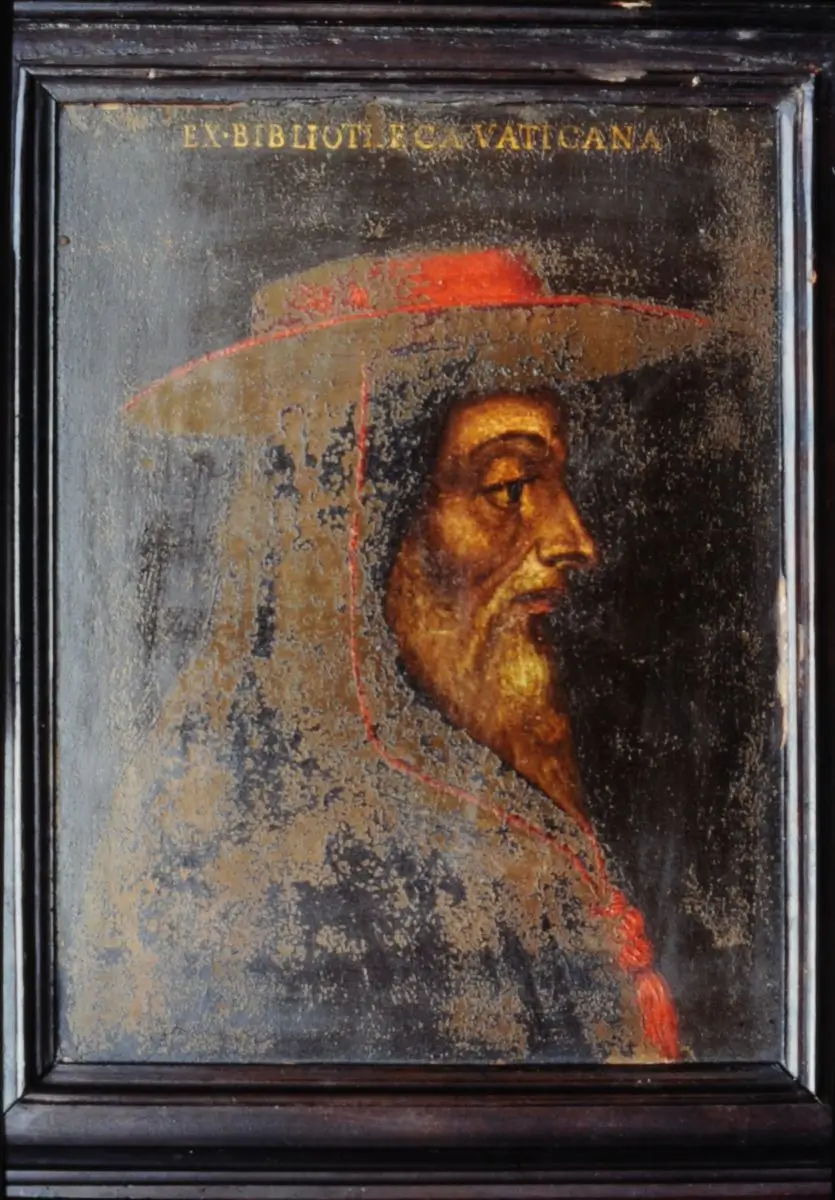
Born in the Greek city of Trebizond, on the Black Sea, at the beginning of the fifteenth century, Basil became a Basilian monk, taking the name Bessarion.
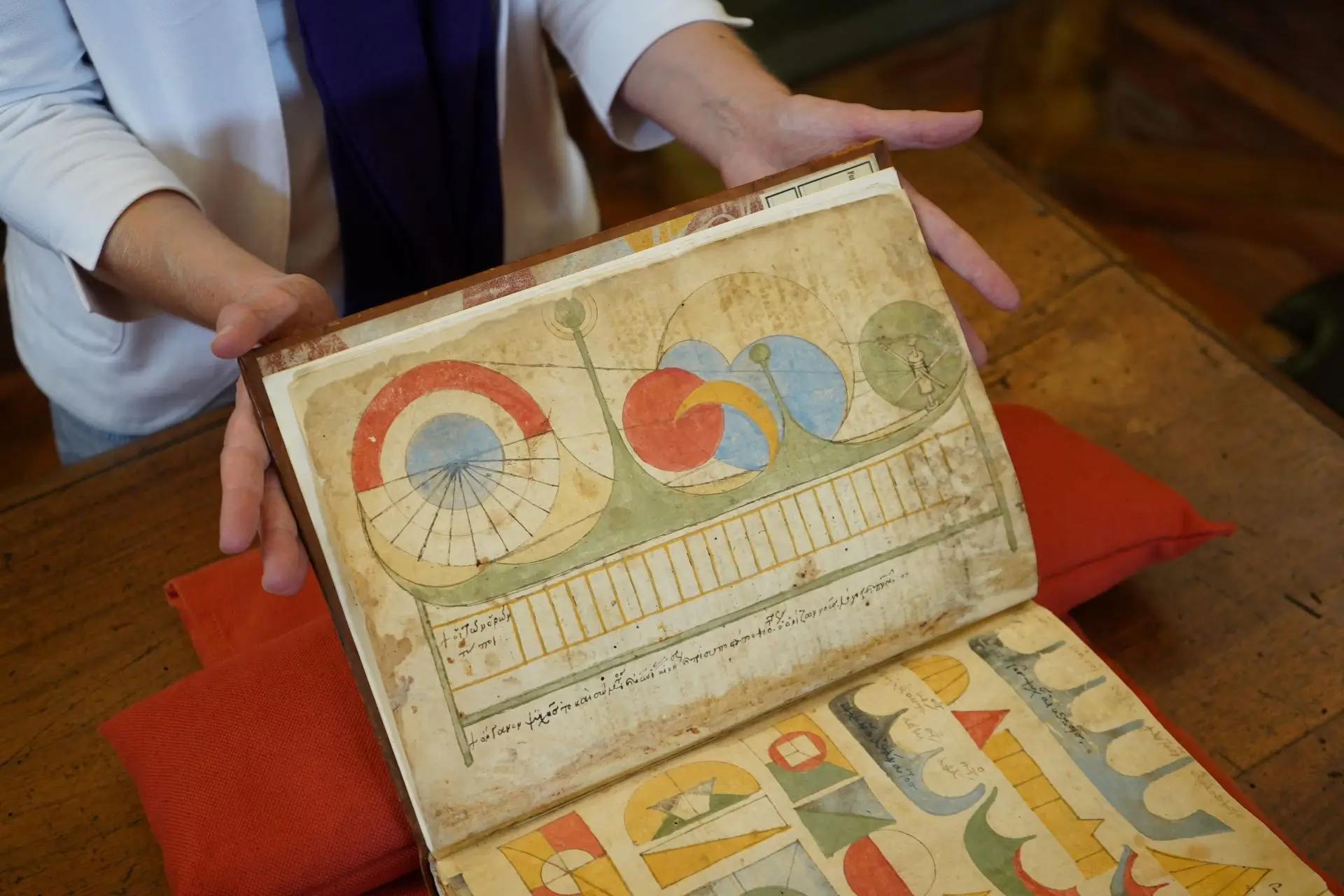
From 1430 to 1436, he studied under the leading Greek philosopher of the time, George Gemistus, known as Plethon. During these years he acquired profound expertise in Platonic and Aristotelian philosophy, mathematics, astronomy, and classical culture more broadly.
In 1438 he was appointed Archbishop of Nicaea. In this capacity, he participated in the Council of Ferrara-Florence, convened by Pope Eugene IV in agreement with the Byzantine Emperor John VIII, with the aim of achieving union between the Western and Eastern Churches.
There he distinguished himself as one of the most prominent figures, and it was largely through his efforts that the Union was proclaimed in Florence on 6 July 1439.
He was created cardinal of the Basilica of the Santi XII Apostoli in Rome in December 1439, thereby becoming a member of the Roman Curia. His permanent transfer to Rome, to his residence at the Lateran, took place in the autumn of 1443.
Thereafter, he remained attached to the papal court, leaving it only to undertake legations entrusted to him by the pope.
As apostolic visitor to the Basilian monasteries of southern Italy and Sicily, he worked for the reform and strengthening of the Order and promoted the continued use and study of the Greek language. In this context, he became closely acquainted with the manuscript collections preserved in these monasteries. In 1456, he was appointed archimandrite of the Abbey of San Salvatore in Messina; in 1462 he became commendatory abbot of Santa Croce di Fonte Avellana and of Grottaferrata.
He was appointed Cardinal-Bishop of Tusculum in April 1449. In May 1463 he received the title of Latin Patriarch of Constantinople; from October 1468 he bore the title of Bishop of Sabina instead of Tusculum.
These titles are recorded in the autograph ownership notes found in his manuscripts.
Appointed legate to France, Burgundy, and England in April 1472, he departed for France but soon returned to Italy. He died in Ravenna, between 17 and 18 November 1472, as a guest of the Venetian podestà Antonio Dandolo. He was buried in the Basilica of the Santi XII Apostoli in Rome.
His mission
Despite the failure of the union between the two Churches, Bessarion continued to advocate ecclesiastical unity through his study of the Church Fathers and his ever-deepening knowledge of Latin texts. This guiding principle is reflected symbolically in the design of his coat of arms, which he began to include in his manuscripts in the early 1450s, when he initiated significant commissions for new codices.
At the same time, he worked tirelessly—also through his writings—to promote a coalition of Western powers capable of resisting the Ottoman Turks’ advance. After the conquest of Constantinople in 1453, he felt an urgent need to establish a library that would ensure the survival of Greek and Byzantine civilisation.
To this end, he succeeded in acquiring or commissioning copies of many of the masterpieces of ancient Greek literature. He was equally concerned to secure a safe repository for his valuable collection and to establish a setting in which Greek and Latin cultures could enter into dialogue.
In 1468, he chose to donate his books to Venice, motivated by his confidence in the Republic’s constitutional structure, his esteem for its leading statesmen, and the affection he had received during his stays in the city. Venice—where a thriving Greek community flourished—appeared to him as a second Byzantium, heir to the Byzantine tradition.
At that time, Venice was the only major power to have assumed the task of resisting Ottoman expansion. From 1463, a protracted and devastating war between the Sultan and the Republic was underway, lasting until 1479.
Further reading
- Lotte Labowsky, “Bessarione”, in Dizionario Biografico degli Italiani, 9, Rome, Istituto della Enciclopedia Italiana, (1967).