

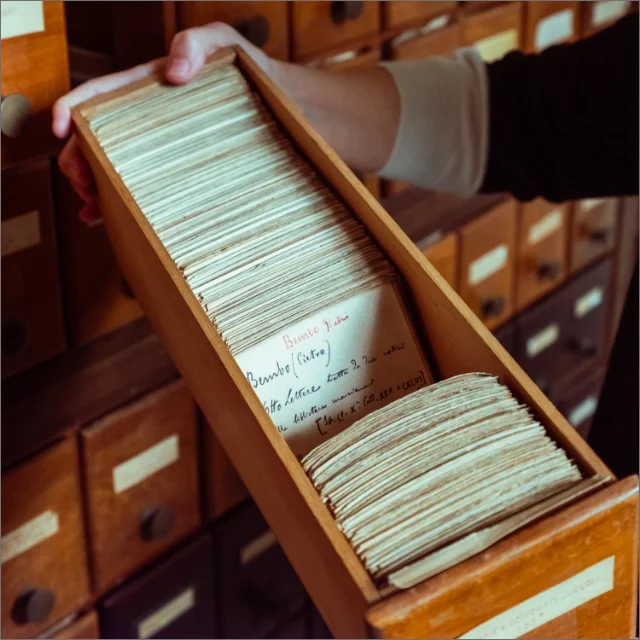
Biographical overview
1619: Girolamo Fabrici d’Acquapendente (13 volumes containing precious anatomical plates in colour)
Girolamo Fabrici d’Acquapendente (born most probably in 1533 in Acquapendente, near Lake Bolsena; died 21 May 1619 in Padua) was a physician and anatomist.
He studied at the University of Padua under Gabriele Falloppio, whom he succeeded in the chair of anatomy, holding the post from 1566 to 1613.
Among those who attended his lectures were the Englishman William Harvey, later discoverer of the circulation of the blood, Caspar Bartholin, and Giulio Cesare Casseri. Among his patients were Galileo Galilei, who was also his friend, and Paolo Sarpi, whom he treated after the attempt on his life.
Fabrici conceived and promoted the construction of the Anatomical Theatre of Padua, inaugurated in 1594, the first permanent anatomical theatre in the world. Towards the end of his teaching career, he began publishing his research, including De formatu fetu (Padua, Pasquati, 1600), considered the first Renaissance treatise on embryology.
In his will, dated 9 November 1615, Fabrici bequeathed to the Most Serene Republic of Venice all his “coloured anatomical paintings, together with the books already printed in which these paintings are to be placed in the Library or elsewhere”.
The bequest reached Venice only after 1622, following the settlement of legal disputes arising after his death. Having had no legitimate children with his wife Violante Vidali—though he is known to have had natural children—Fabrici left the greater part of his estate to his great-granddaughter Semidea, to whom he was deeply attached and who married the Venetian patrician Daniele Dolfin, one of his former pupils.
Semidea died prematurely, and the inheritance passed to another great-granddaughter, Francesco Benci. The Reformers of the University of Padua, aware of the testamentary provisions in favour of the Library, took steps to recover the anatomical paintings destined for it.
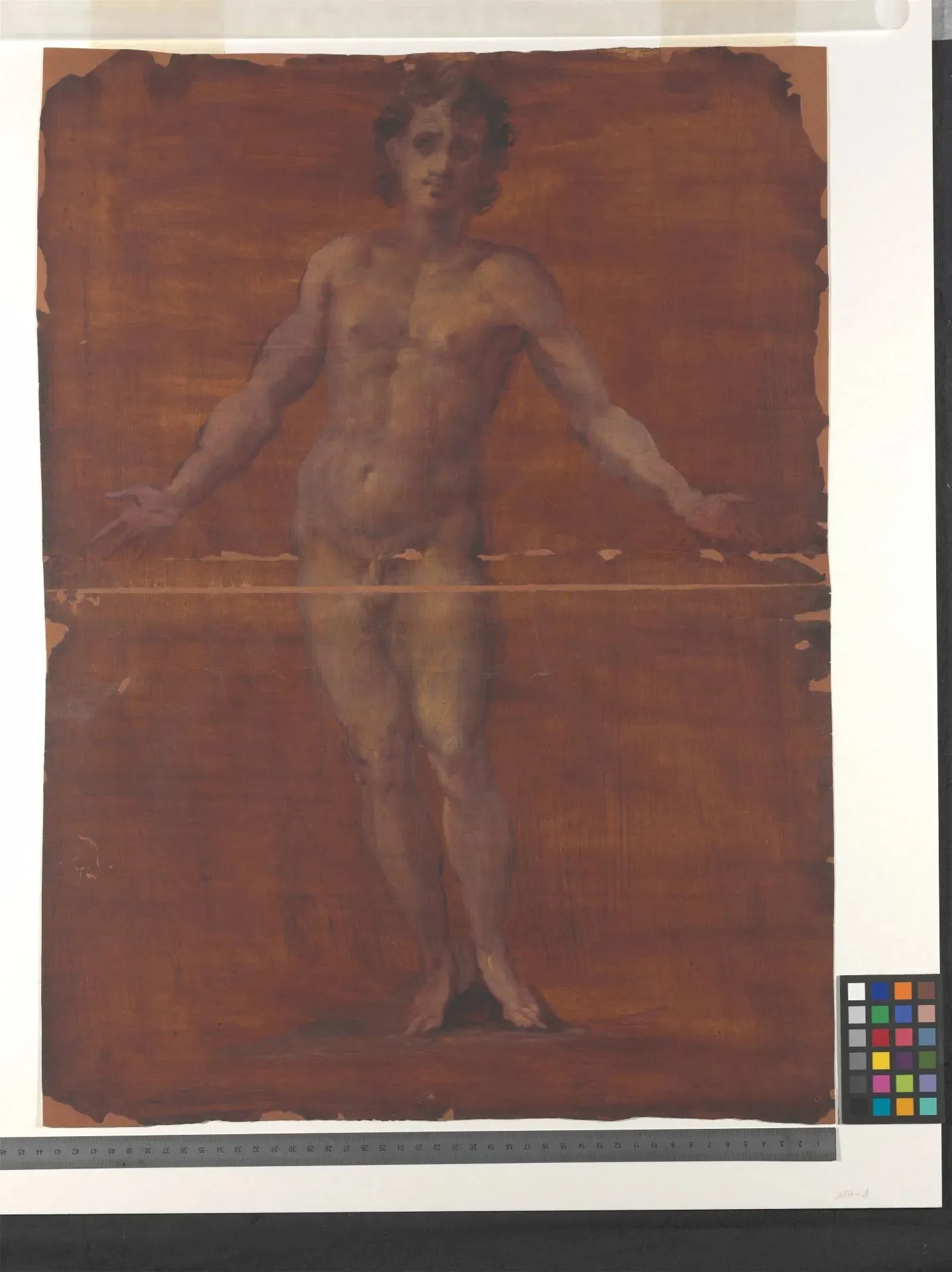
The Tabulae anatomicae
The Tabulae anatomicae reached the Library of St Mark in the form of eight parchment-bound volumes containing 167 plates (Rari 110–117), together with three volumes of proofs of seven of his printed works, comprising 45 painted plates and 56 engravings reproducing the painted subjects (Rari 118–120).
The plates were executed on paper in oil colours under the direct supervision of Girolamo Fabrici d’Acquapendente. In many cases, the holes used to suspend them during anatomy lessons for the instruction of students are still visible.
The work is closely connected with the Paduan milieu and has been associated with the painter Dario Varotari the Elder. Between 1994 and 1996, the entire corpus underwent restoration, which restored the flexibility of the paper supports and repaired structural damage.
Particularly valuable are the two plates depicting the full human figure, shown from the front and from the back (Rari 114.1–2), which display a pronounced pictorial quality.
Fabrici’s will is preserved in Padua, Notarial Archive, Liber 2.s, Instrumentorum Marci Franzini Notari, 1612 usque 1633, bundle no. 2969 (red series), cc. 191r–198v.
Further reading
- Il teatro dei corpi. Le pitture colorate d’anatomia di Girolamo Fabrici d’Acquapendente, edited by Maurizio Rippa Bonati and José Pardo-Tomás, Milan, Mediamed, 2004 (catalogue of the exhibition held in Venice, 2004–2005).
- Francesca Zen Benetti, “La libreria di Girolamo Fabrici d’Acquapendente,” Quaderni per la storia dell’Università di Padova, 9–10 (1976–1977), pp. 161–171.