

Walls and Ceiling
The walls
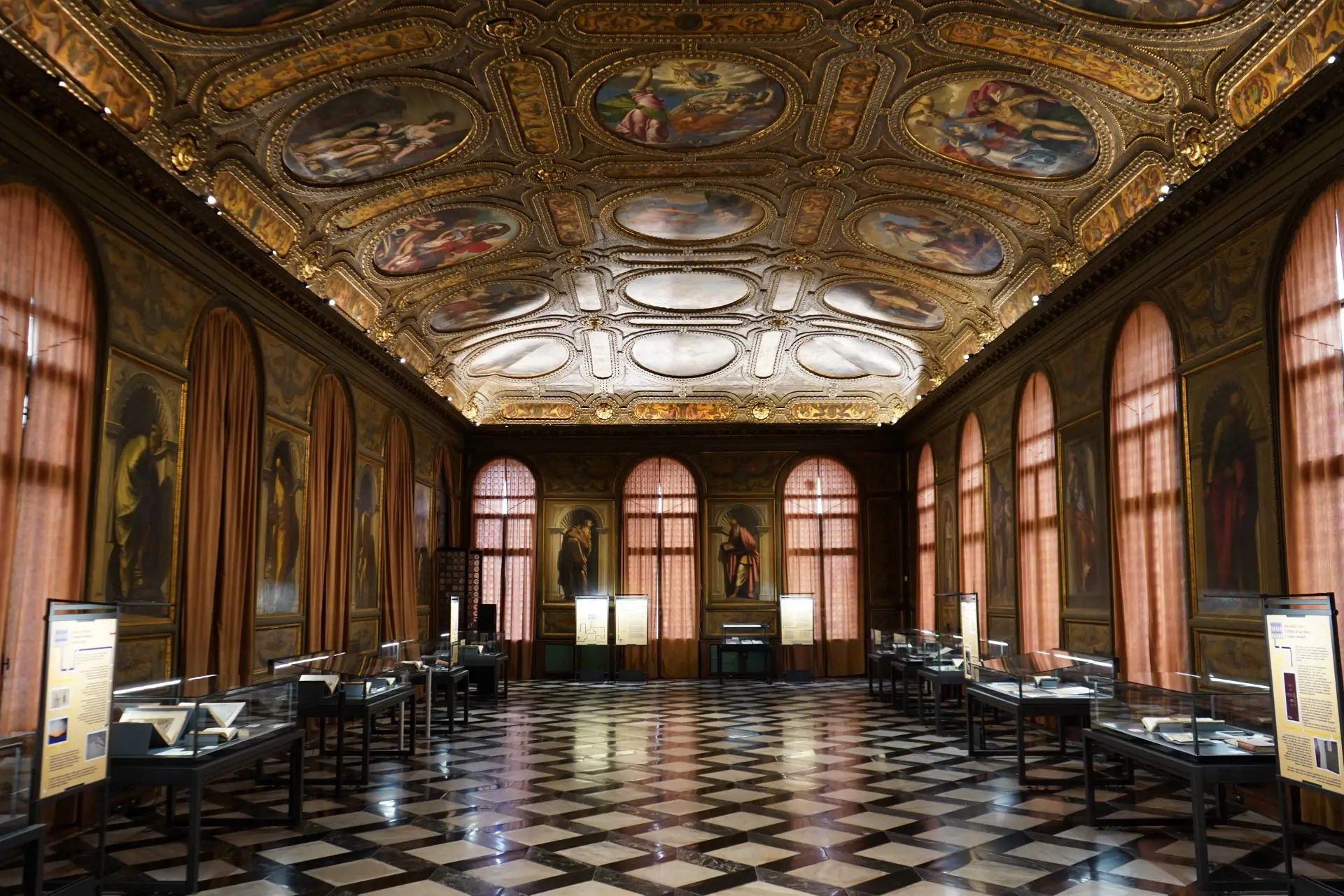
Between 1562 and 1572, numerous portraits of ancient philosophers were placed on the walls to create an atmosphere reminiscent of the libraries of antiquity.The great artist excluded from the ceiling cycle, Jacopo Tintoretto, also contributed to this cycle; he had, moreover, already been active in the decoration of the Vestibule, with paintings now dispersed across various collections.
The two philosophers on either side of the portal are by Paolo Veronese.
On the left-hand wall, the first two are by Andrea Schiavone. These are followed by four philosophers by Tintoretto (the most admired of his philosophers was once Diogenes, the penultimate figure on the left-hand wall). The two on the back wall are also by Tintoretto (though there is some uncertainty regarding the one on the right).
On the right-hand wall, facing the Piazzetta: Faith, by the Veronese school; Prometheus, by Giuseppe Porta, known as Salviati (the head was later repainted by Pietro Vecchia); the prophet Jeremiah, by the same artist; a philosopher by Battista Franco; a Philosopher by Lambert Sustris; Charity, by the Veronese school.
(With the exception of the two philosophers, the paintings on this wall do not belong to the original cycle. The attributions are by Nicola Ivanoff.)
The ceiling
Given the significance and number of the works, the ceiling has been described as the manifesto of Mannerism in Venice
The first three tondi (starting from the entrance), those by Giovanni De Mio, known as Fratina (from the right: Nature, Pallas, Jupiter; Theology before the Gods; Natural Philosophy), are the furthest removed from traditional Venetian painting, owing to the predominance of drawing and the use of cool, brown tones.
Giuseppe Porta, known as Salviati (second sequence of tondi, from the right: Virtue Scorns Fortune; Art, Mercury, Pluto; Pallas, Hercules), and Battista Franco (third sequence of tondi; from the right: Agriculture, Pomona, Ceres, and Vertumnus; Diana and Actaeon; Diligence, Labour, and Exercise) appear to be linked to their training in Rome.
Giulio Licinio (fourth set of three tondi, from the right: Vigilance, Patience; Glory and Bliss; the third tondo, Sculpture, was repainted by Bernardo Strozzi in 1635) shows the influence of Titian and Franco.
Giovanni Battista Zelotti (fifth sequence of tondi, from the right: Mathematics; Good Habits; Virtue; the last tondo, Nile, Atlas, Geometry, and Astrology, was executed by Padovanino in 1635) attempts to rival Paolo Veronese.
Veronese (penultimate sequence of tondi, from the right: Honour; Arithmetic and Geometry; Music) triumphs with the brilliance of his colours, with which, as Carlo Ridolfi wrote in the seventeenth century, “he gave rein to joy, made beauty majestic, and rendered laughter more festive.”
The chromatic fluidity of the final three tondi by Andrea Meldolla (known as Schiavone) (Government; The Priesthood; Arms) brings the cycle to a close.
Two tondi, damaged by rain, were repainted in 1635: those by Padovanino and Bernardo Strozzi.
The artists responsible for the ceiling, who had been chosen by the Procurators of St Mark’s in agreement with Sansovino and Titian, unanimously declared that the finest among them had been Veronese; and the Procurators presented him, as a token of gratitude, with a gold chain. So recounts Ridolfi, who saw the chain in the home of a nephew of Veronese.