

Biographical overview
1814: Girolamo Ascanio Molin (2,209 highly valuable printed works)
Girolamo Ascanio Molin belonged to the dal Molin d’Oro branch of the ancient Molin family, which had settled in Venice around the year 1000.
Over the centuries, numerous members of the family held important offices within the Republic; among them was Francesco Molin, elected Doge in 1646, the ninety-ninth Doge of the Serenissima. Girolamo Ascanio (1738–1814), son of Giangirolamo and Caterina Grassi, studied at the Collegio dei Nobili di S. Carlo in Modena. In 1779 he married Marina Bernardo, with whom he had two daughters.
He played an active role in Venetian political and administrative life—serving as Savio agli Ordini, Senator, member of the Council of Ten, and State Inquisitor. His reputation is linked both to his historical and literary activity—he authored, among other works, the anti-Napoleonic pamphlet Venezia tradita (1779), translated Andrea Morosini’s Storia della Repubblica veneziana dal 1551 al 1615, and began an unpublished and unfinished Storia della Repubblica di Venezia negli ultimi cinque lustri—and above all to his collecting.
Continuing a well-established family tradition, he assembled a rich collection of paintings, coins, statues, manuscripts, books, prints, and natural history artefacts, which he bequeathed to the Comun di Venezia in his will dated 24 February 1813.
The bequest
The will provided, among other dispositions, that 4,000 volumes from Molin’s library were to be “selected at the discretion of the Librarian of St Mark” and entrusted, together with “prints and drawings, cameos, engraved stones, small bronzes, vases … to the Royal Library of St Mark in Venice, to be preserved in perpetuity for the benefit of the studying public.”
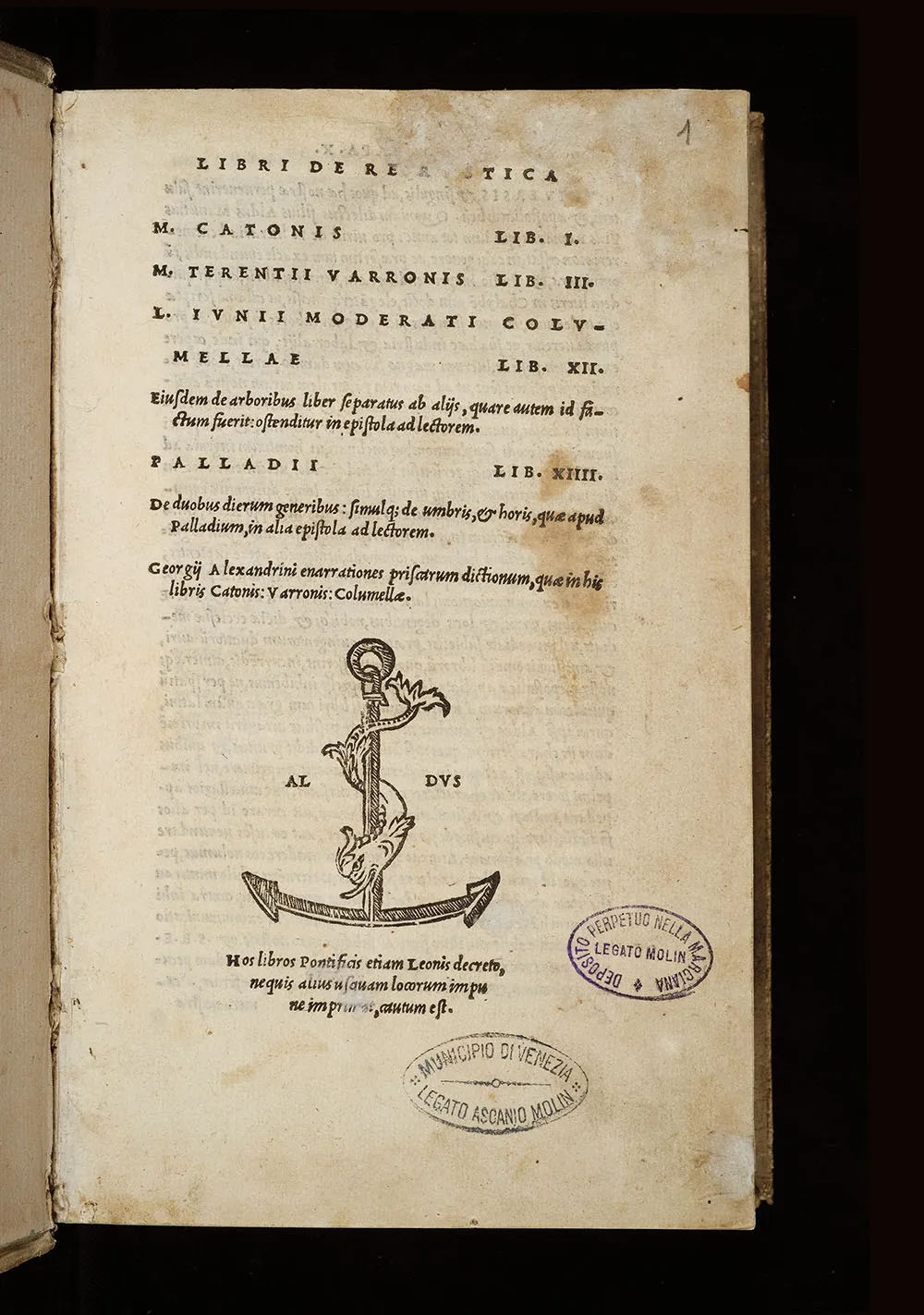
The selection was carried out by Jacopo Morelli and Pietro Bettio, respectively custodian (director) and deputy custodian of the Marciana. In 1816, the following entered the Library: 2,209 rare and valuable works in 3,606 volumes (including numerous incunabula and Aldine editions), 3,835 prints, 408 drawings, 136 maps, 97 cameos, 73 marbles, 292 bronzes, 89 terracottas, 36 ivories, 29 antique glassware, 122 miscellaneous objects, and a medal collection comprising 9,570 pieces of significant historical and documentary value.
In 1873, the Municipality of Venice requested the “return” of all books, works, and objects deposited at the Marciana, since the 1813 will designated the Municipality as the beneficiary of the entire bequest.
The dispute continued for many years. In 1886, an agreement was finally signed between the Ministry and the Municipality, “definitively establishing that ownership of the objects belonged to the latter, while the State retained the right to determine their use and place of preservation” (Zorzi, 396). The bequest was consequently transferred to the Museo Correr, with the exception of the books, which were left to the Marciana “in perpetual use.”
Inventories and catalogues
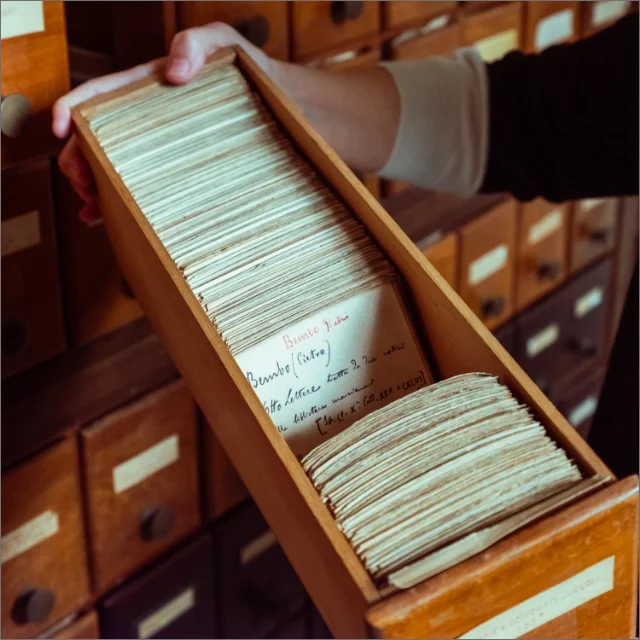
The volumes from the Molin bequest are dispersed throughout the Library’s collections and do not constitute a separate, self-contained collection. Their identification in the catalogue—i.e. in a way that is transparent to users—is possible, though not exhaustively, by searching the field “possessore” in the local OPAC.
A substantial corpus of correspondence, both sent and received by Molin, is preserved in three volumes that document his collecting activity in remarkable detail (Mss. It. X, 195–197 = 6689–6691).
Further reading
- Marino Zorzi, La Libreria di S. Marco, Milan, Mondadori, 1987, esp. pp. 394–396.
- Rizzi, Girolamo Ascanio Molin. Un collezionista veneziano tra Sette e Ottocento (undergraduate thesis), University of Venice, Faculty of Arts and Humanities, academic year 1991–1992.