

Biographical overview
1819-1877: Iacopo Morelli (bequest of 600 manuscripts and several bundles of scholarly papers, and 1,243 volumes of printed pamphlets; acquisition of 131 bundles of papers and manuscripts)
Iacopo Morelli (15 April 1745 – 5 May 1819) was born in Venice to parents originally from Ticino. He studied with the Dominican Gesuati at the Zattere and learned Greek under Giovanni Battista Gallicciolli.
There he met Father Giovanni Bernardo De Rubeis, who introduced him to the rich Venetian monastic libraries. Having embraced the priesthood, Morelli devoted his life to scholarship.
His extensive knowledge of classical, historical, and literary texts enabled him to compile the catalogues of the Latin and Italian manuscript collections of the patrician Tommaso Giuseppe Farsetti (published between 1771 and 1788) and of Giacomo Nani (published by Zatta in 1776). Together with his friend Farsetti, he also visited the principal libraries of Padua, Vicenza, and Verona.
The publication of Della pubblica libreria di San Marco in Venezia. Dissertazione storica (Venice, Zatta, 1774) earned him—supported by Farsetti—the appointment as Custodian of the Library in 1778, following the death of Anton Maria Zanetti.
Morelli served for a long time as custodian during the tenure of the patrician librarians Girolamo Grimani (1716–1780) and Girolamo Ascanio Giustinian (1721–1790), briefly replaced by Alvise Pietro Contarini (1731–1786), Zaccaria Vallaresso (1686–1769), and Francesco Pesaro (1740–1799).
After the fall of the Republic, from 1797 until his death, Morelli personally continued to direct the institution, now named the “National Library” and later the “Royal Library.”
Meanwhile, with the succession of different governments, he was obliged to accommodate the French and Austrian authorities, placing his own knowledge of the Venetian libraries, together with that of his subordinate Pietro Bettio, at the service of the operations carried out during the suppressions.
He selected and secured for the public collections important manuscripts, incunabula, and rare books, so that they would not reach the market and be dispersed.
Among the public offices he held, from 1792 he served as reviewer of foreign books (alle dogane, i.e. at the customs office), a post he retained even after the fall of the Republic.
Public interest also guided his supervision of the mandatory deposit of printed works, which helped to leave a record of published works in the Library.
Meanwhile, he worked to expand the spaces assigned to the Library and to the antiquities collections.
Those complex years did not spare him, in 1811, the forced transfer of the Library to the Doge’s Palace, into the Hall of the Great Council and the adjoining rooms.
He died at the age of seventy-four, still active: sixty-two printed works had appeared, and he left innumerable drafts of works, lists, correspondence, and his valuable notebooks (Zibaldoni).
He was buried on San Michele island.
The bequest and the acquisition
Morelli’s manuscripts reached the Library through two distinct channels.
Upon his death in 1819, Jacopo Morelli bequeathed to the Library his manuscript codices together with numerous volumes of bound printed pamphlets.
The will is largely transcribed by Giuseppe Valentinelli (Bibliotheca, I, pp. 136–138): “Having, from the earliest years of my youth, taken care to collect valuable manuscript codices, I have assembled a significant number of them; and it is fitting that I should ensure that they be kept together after me.
Therefore, I order and wish that they be delivered by my sister Laura to the Imperial Royal Library of Venice, to which I wish them to be transferred after my death, and that there they be perpetually and faithfully preserved for the use of scholars who will know how to make proper use of them, and for the advancement of learning; and to these manuscripts shall be joined the printed books with handwritten notes that are found inserted among the said codices.”
He also included in the bequest his “most precious miscellany of printed books”, together with “fourteen bundles of papers tied with string, containing my studies on the manuscript codices of the same Library, both unpublished and printed in the first volume of my Bibliotheca graeca et latina, of which there is attached a printed copy with my handwritten additions and corrections, and a copy of my Dissertazione storica on the aforesaid Library, likewise with my handwritten additions and corrections”; and “among the same bundles there will be one containing my studies on the antiquarian museum annexed to the Library.”
Another substantial part of Morelli’s library reached the Marciana later through purchase, following inheritance proceedings.
Pietro Bettio (1769–1846), long-time collaborator of Morelli and his heir, was compelled to sell the collection because of family financial difficulties, in particular to Francesco Foramiti of Cividale.
Subsequently, Morelli’s manuscripts and correspondence—constituting a large part of those that had come from Bettio—were offered to the director of the Biblioteca Marciana, Giuseppe Valentinelli, who was unable to purchase them because of their high price.
Put up for sale with a catalogue in 1847, the manuscripts remained at the Abbey of Santa Maria della Misericordia with Abbot Pietro Pianton, a passionate defender of works of art, who died in 1864; public acquisition was achieved only in 1877, when the State purchased them for the Biblioteca Marciana.
Extent and composition
The bequest brought 600 manuscripts, to which were added several bundles of studies and 1,243 volumes of bound printed pamphlets, calculated to contain approximately 20,000 works.
The manuscripts date chiefly from the fifteenth and sixteenth centuries.
Valentinelli noted that the collection contained one codex from the eleventh century, five from the twelfth, and four from the thirteenth.
There were twenty-two Greek codices, and an equal number of others, divided between Latin and vernacular manuscripts.
The subjects represented are chiefly Venetian, Paduan, and Milanese history; ecclesiastical, civic, and guild statutes; geography, archaeology, and the fine arts; epigraphy; medicine; astronomy and astrology.
Interest in literature is demonstrated by the presence of poetry, letters, and writings from the humanistic period.
With the purchase of 1877, a further 131 bundles of papers and manuscripts were acquired, now preserved under the shelfmark Archivio Morelliano
Among the Greek manuscripts, mostly dating from the fifteenth and sixteenth centuries, the twelfth-century Menologium for the month of November, Gr. VII, 53 (=1304), stands out.
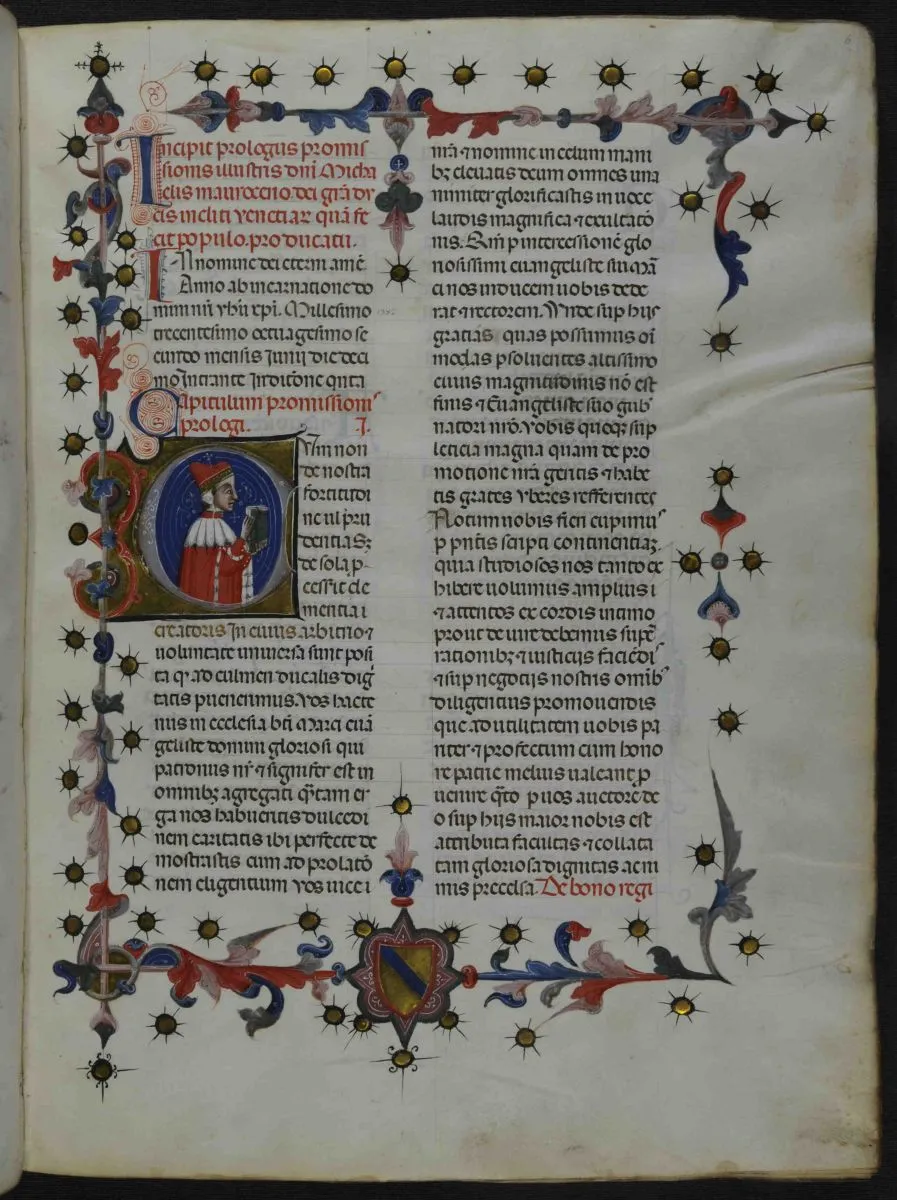
Among the Latin codices relating to Venetian history, rare illuminated examples include the Promissione of Doge Michele Morosini (1382), Marcian codex Lat. X, 189 (=3590), and the commission issued by Doge Leonardo Loredan to Paolo Antonio Miani, sent as Duke of Crete, in 1516, Lat. X, 234 (=3849).
The Library also acquired ten of Morelli’s notebooks, rich in notes on manuscripts examined in various libraries (Archivio Morelliano 35–44 = 12541–12550): the autograph Zibaldoni A–K, containing excerpts from manuscripts, information on codices and rare books, and erudite memoranda on literature, science, and the fine arts. These materials still await systematic publication or detailed analytical indexing.
The inventories
The bequest
- Indice delli codici manoscritti latini, greci, italiani ed altri di me don Giacomo Morelli R. C. Cav. Bibliotecario da esser consegnati alla I. R. Biblioteca di Venezia dopo la mia morte, compilato e scritto di mia mano [Iacopo Morelli] nel decembre 1817 e gennaro 1818, It. XI, 325 (=7136), formerly Riservati 136.
This is a list of 435 manuscripts in 454 volumes. On pp. 77–88, Pietro Bettio adds a list of a further 146 of Morelli’s codices delivered to the Library; on pp. 88–89 he indicates the other components of the Morelli bequest. - Repertorio delle materie intorno alle quali versano gli Opuscoli Miscellanei posseduti dal chiarissimo Abate Iacopo Morelli R. Consigliere Bibliotecario, compilato dall’Abate Pietro Bettio suo assistente nella R. Biblioteca, It. XI, 326–327 (=7137–7138), formerly Riservati 88–89.
The acquisition
- Catalogo degli studi e carteggi del fu bibliotecario della Marciana ab. Jacopo Cav. Morelli, esistenti presso l’ill.mo e r.mo monsignor fr. Pietro dott. Pianton abate di S. M. della Misericordia, dei quali i proprietari vogliono fare la vendita, Venezia, co’ tipi di P. Naratovich, 1847; also published in Serapeum, VIII (1847), pp. 209–217 (Marciana copy: Cons. Cat. Mss. Marc. 20B). A printed catalogue, annotated by hand with the shelfmarks assigned in the Library.
The collection was revised in the 1970s by Stefania Minutelli Rossi.
Further reading
- Giannantonio Moschini, “Narrazione intorno alla vita ed alle opere di D. Iacopo Morelli,” in Operette di Iacopo Morelli, bibliotecario di S. Marco, I, Venice, Tipografia di Alvisopoli, 1820.
- Carlo Palumbo Fossati, “Le origini ticinesi di J. M. bibliotecario della Marciana,” in Lettere venete, 10–11 (1976), nos. 31–36, pp. 174–182.
- Marino Zorzi, La Libreria di S. Marco, Milan, Mondadori, 1987, pp. 285–297, 349–371.
- Alessia Giachery, Jacopo Morelli e la repubblica delle lettere attraverso la sua corrispondenza (1768–1819), Venezia, Marcianum Press, 2012