

Biographical overview
1792: Tommaso Giuseppe Farsetti (350 manuscripts and printed works)
Tommaso Giuseppe Farsetti (1720–1791), a cultivated bibliophile, was born in Venice to a family of Tuscan origin that had been granted Venetian nobility in 1664 but was already distinguished by considerable wealth. He resided in Palazzo Dandolo in the parish of San Luca.
Farsetti soon withdrew from public life in Venice to devote himself to literary studies. He travelled extensively throughout Europe and, upon returning to his home city, was appointed bailiff and commander of the Order of St John of Jerusalem.
He was acquainted with leading Italian and French writers of the time, translated texts from Latin and Greek, and composed poetry in both languages. In 1758 he was admitted to the Accademia della Crusca.
He maintained correspondence with scholars in Padua, Rome, Florence, Ferrara, Brescia, Bologna, Bergamo, and Rovereto, and while abroad remained in close contact with Venetian intellectuals such as Domenico Maria Mazzucchelli and Gasparo Gozzi.
His travels in England, France, and throughout Italy offered him opportunities to acquire manuscripts and rare books. He died in Padua on 30 October 1791.
The bequest
Aware that he had no direct heirs, Farsetti stipulated in his will of 30 September 1786 that his possessions should be assigned—either directly or through their sale—to friends and servants, but above all to public institutions.
He bequeathed his manuscripts, printed books, and theatrical works to the Library of the Serenissima, with the explicit intention that they should remain united within the Venetian collections.
He further provided that his collection of medals of illustrious men and his bronzes should also become public property. In recognition, the Serenissima commemorated him with a plaque placed at the foot of the Library staircase.
In doing so, he effectively entrusted his collections to the care of his friend Morelli, who had already collaborated with him for many years in organising and cataloguing them during their long and close friendship.
Extent and composition
The collection was delivered on 10 March 1792. In his report to the Senate dated 30 April of the same year, the Librarian Zaccaria Vallaresso confirmed that he had received all the materials. He specifically noted the manuscript books—386 in Latin and Italian—and emphasised that the works in the Tuscan language and the series of Italian comedies amounted to 1,650 items.
Tommaso Giuseppe Farsetti’s interests embraced the works of major authors and literary compositions, but also literary curiosities, in keeping with a Venetian habitué of Enlightenment circles and a member of the Accademia dei Granelleschi.
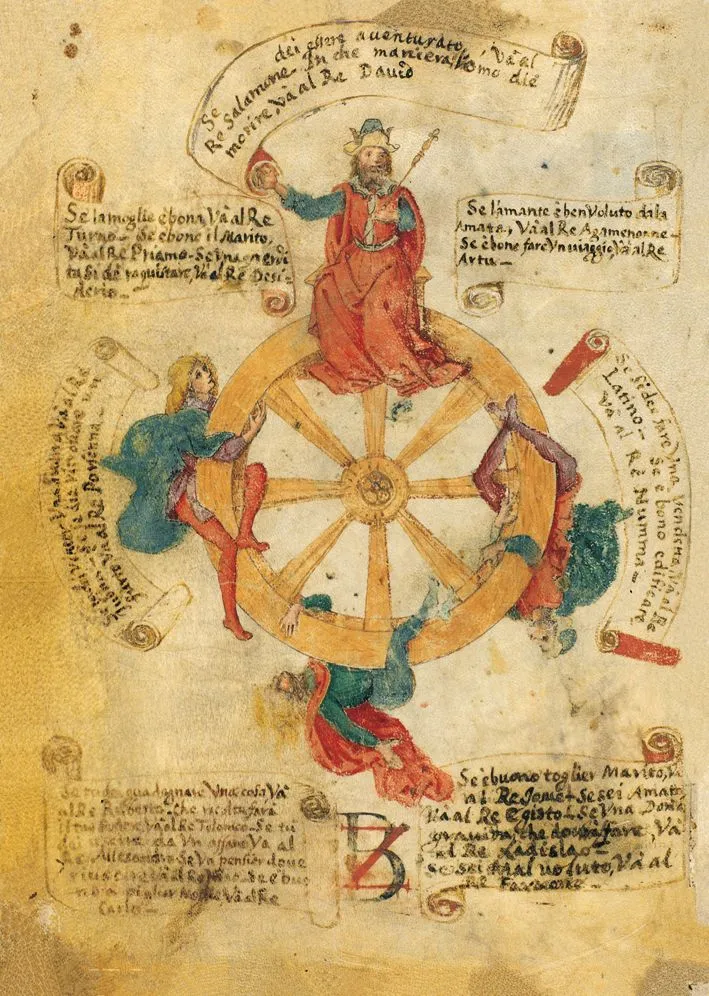
Among the manuscripts, particular mention should be made of Lorenzo Spirito’s Libro delle sorti, a Perugian manuscript dated 1482 (It. IX, 87 = 6226), finely illuminated and containing a work that enjoyed great popularity during the Renaissance and has recently been published in facsimile.
Also noteworthy is the lively satire Momus sive de principe by Leon Battista Alberti, preserved in the Marcian codex Lat. VI, 107 (= 2851). Written in humanistic script (antiqua) by several hands with similar characteristics and datable to the early third quarter of the fifteenth century, it contains numerous marginal corrections in Alberti’s own hand.
The collection of small bronzes and “medals of illustrious men”, as Farsetti described his rich set of Tuscan Baroque medals, was likewise destined for the antiquarian collections of the Serenissima, and thus for the Library.
Following the subsequent reorganisation of the State collections, the ancient objects were assigned to the new Archaeological Museum. Later, with the opening to the public of the Franchetti Gallery at Ca’ d’Oro in 1927, the Renaissance and later works were transferred there.
The inventories
Before the bequest was effected, Farsetti’s friend Jacopo Morelli had already described the manuscript collection in: Biblioteca manoscritta di Tommaso Giuseppe Farsetti, patrizio veneto e balì del Sagr’Ordine Gerosolimitano, Part I, Venice, Fenzo, 1771.
This volume contains the catalogue of Latin manuscripts (nos. 1–78) and vernacular manuscripts (nos. 1–165) [copy annotated with Marciana shelfmarks: Cons. Cat. Mss. Marc. 10]. Part II, Venice, Pietro Savioni, 1780, includes the catalogue of Latin manuscripts (nos. 79–114) and vernacular manuscripts (nos. 166–236) [copy annotated with Marciana shelfmarks: Cons. Cat. Mss. Marc. 10].
- Tommaso Giuseppe Farsetti – Jacopo Morelli, Catalogo de’ libri latini, Venice, Antonio Graziosi, 1788. This is the list of printed books, to which is appended [Part III] the catalogue of Latin manuscripts (nos. 115–122) and vernacular manuscripts (nos. 237–264)
[copy annotated with the Marciana shelfmarks of the manuscripts: Cons. Cat. Mss. Marc. 11]. - Ms It. XI, 329 (= 7139): Catalogo delle medaglie di uomini illustri poste nella cassa B, compiled by Jacopo Morelli, with later additions by Gio. Antonio Bonicelli, Deputy Librarian, and by Giuseppe Valentinelli and his successor.
Further reading
- Vincenzo Lazari, Della raccolta numismatica della Imp. Regia Libreria di S. Marco. Informazione, Vienna, K. Gerold’s Sohn, 1858; Museo della casa eccellentissima Farsetti in Venezia, s.n.t.
- Giovanni Sforza, “Il testamento d’un bibliofilo e la famiglia Farsetti di Venezia,” in Atti della Reale Accademia delle Scienze di Torino, s. 2, LXI, 1910–1911, pp. 153–195.
- Bruno Brunelli Bonetti, “Dal carteggio di Tommaso Giuseppe Farsetti,” in Atti dell’Istituto Veneto di Scienze, Lettere ed Arti, vol. CVII, part II, 1948–1949, pp. 151–163.
- Marino Zorzi, La Libreria di San Marco, Milan, Mondadori, 1987, pp. 303–305.