

Biographical overview
1468: Bessarion (548 Greek manuscripts, 337 Latin manuscripts, and 27 incunabula)
Bessarion—probably born Basilios (Trebizond, c. 1400 – Ravenna, 18 November 1472)—was a gifted young Greek who, after beginning religious, literary, and philosophical studies, entered the Basilian Order in 1423, taking the name Bessarion.
He combined his scholastic and ascetic training with studies in the natural sciences and Platonic philosophy, which he pursued at Mistra under the guidance of George Gemistus Plethon.
Having advanced through the ecclesiastical hierarchy—he was known as Cardinal Niceno because he had been Metropolitan of Nicaea from 1437—and enjoying imperial favour, he was chosen to participate in the Council of Ferrara. In October 1438, he delivered the inaugural oration, calling for ecclesiastical unity.
He was created Cardinal-Priest of the Basilica of the Santi Dodici Apostoli in Rome in December 1439 and was thus incorporated into the Roman Curia. His definitive transfer to his residence at the Lateran took place in the autumn of 1443.
Thereafter, he remained at the papal court, leaving Rome only for diplomatic and legatine missions entrusted to him by the Pope.
The bequest
In 1468, Bessarion chose to donate his books to St Mark’s—and therefore to the Venetian Republic. The collection was transferred partly during his lifetime (1468) and completed after his death (1472). In Bessarion’s vision, Venice was to serve as a bulwark against the Turks and a secure refuge for the Byzantine intellectual world, of which he considered himself an heir. At the same time, he hoped it would become a place of encounter and dialogue between Greek and Latin cultures.
Initially, he had intended to donate the collection to the monastery of San Giorgio Maggiore, owing to the presence there of a library modelled on the Medici Library and to his good relations with the Benedictine monks.
In formalising his bequest—the original deed of which is preserved in codex Lat. XIV, 14 (= 4235)—Bessarion stipulated conditions for the protection and custody of the books and requested that they be housed in a setting worthy of both the collection and its readers.
Extent of the bequest
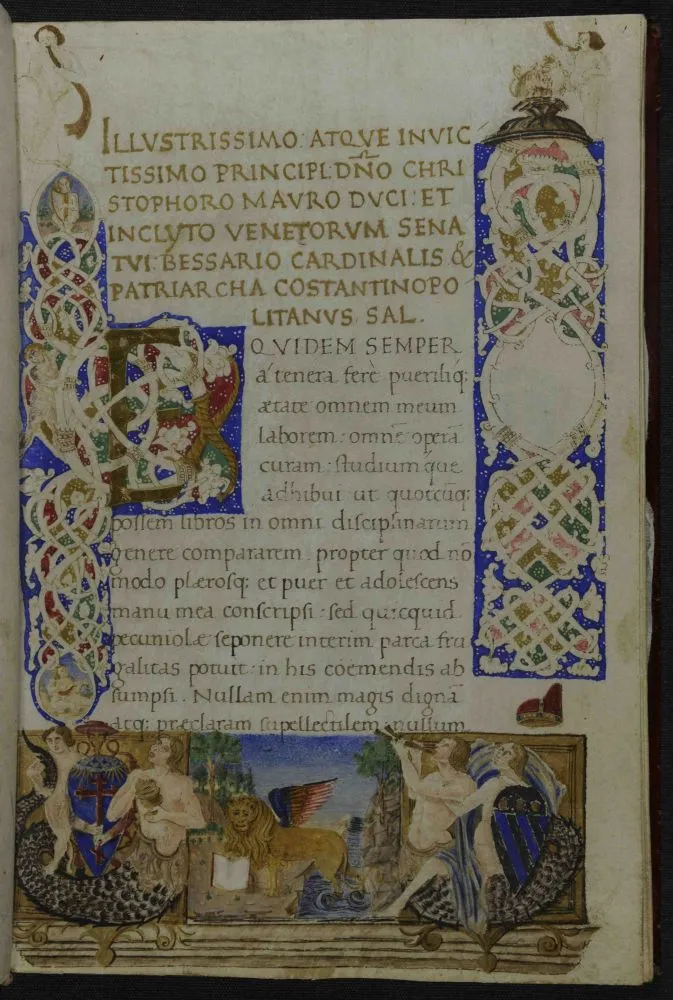
The original deed of donation of the Bessarion Library is preserved in the Marciana as codex Lat. XIV, 14 (= 4235). Elegantly executed and enclosed in a contemporary casket, it bears the title: Acta ad munus literarium D. Bessarionis cardinalis Nicaeni, episcopi Tusculani et patriarchae Constantinopolitani, in Serenissimam rempublicam Venetam collatum spectantia.
The text opens with the letter in which Bessarion informs Doge Cristoforo Moro of his intention to donate his library to St Mark’s, dated ex balneis Viterbiensibus, 31 May 1468.
This is followed by:
- The bull by which Pope Pietro Barbo (Paul II) ratifies the revocation of Bessarion’s earlier intention to donate the library to the Venetian monastery of San Giorgio Maggiore and approves its new destination. The document is dated datum Romae, apud Sanctum Marcum, anno Incarnationis Dominicae millesimo quadringentesimo sexagesimo septimo, sexto decimo Kal. Octobris, with notarial authentications dated 14 June 1468.
The Instrumentum donationis librorum, drawn up in Viterbo on 14 May 1468 by the notary Rosato, son of Matteo of Viterbo. - The Index librorum utriusque linguae quos Bessario cardinalis et patriarcha Constantinopolitanus basilicae Beati Marci Venetiis dicavit, divided into a catalogue of Greek books and a catalogue of Latin books, followed by the notarial attestation.
This is followed by the text relating to the formal transfer into Venetian hands, likewise accompanied by the act of ratification. Once the donation had been accepted by the Serenissima, the Venetian ambassador to the Holy See, Pietro Morosini, took possession of the library through a deed drawn up in Rome, at the cardinal’s residence at Santi XII Apostoli, on 26 June 1468. - The original deed of donation lists 482 Greek and 264 Latin manuscripts.
In the spring of 1469, the first thirty crates arrived in Venice, containing 466 of the manuscripts included in the catalogue.
All the remaining manuscripts, augmented by further acquisitions, arrived in a second shipment in February 1474, since the inter vivos donation stipulated that some of the codices required for the cardinal’s own studies were to remain in his possession, and were therefore sent from Urbino, where he had placed them for safekeeping with Federico da Montefeltro.
Today, the collection comprise 548 Greek manuscripts, 337 Latin manuscripts, and 27 incunabula.
Types of materials
The Bessarion Library was initially assembled for purposes of study and later with the explicit aim of preserving the writings and wisdom of the ancients, regarded as the foundation of civilisation.
The collection therefore includes ancient manuscripts sought out in their regions of origin, in territories of Greek tradition under Latin rule, and in centres of Latin culture.
Alongside these are newly produced volumes—true “editions” of texts—specially commissioned, both in terms of copying and, in many cases, illumination.
Many of the manuscripts are described by Bessarion as pulcherrimi, that is, of exceptional quality and aesthetic refinement.
The textual content ranges across literary, theological, philosophical, and scientific works.
Notable manuscripts
Within this celebrated library are numerous manuscripts that constitute fundamental witnesses to the textual tradition, iconography, and intellectual history of Western civilisation.
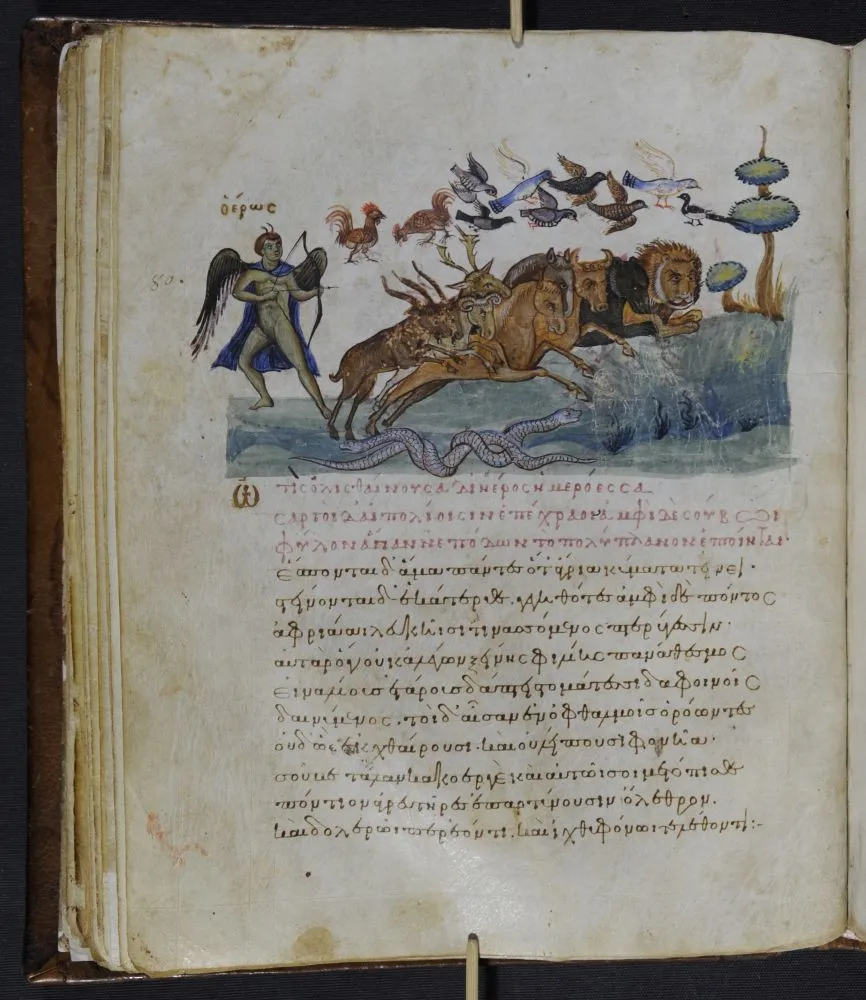
Among the ancient codices, we note the manuscripts of the Iliad, designated A and B in the stemma of the work (Gr. Z. 454 = 822; Gr. Z. 453 = 821) and available online on the website of Harvard’s Center for Hellenic Studies, as well as Oppian’s Cynegetica (Gr. Z. 479 = 881), recently reproduced in facsimile.
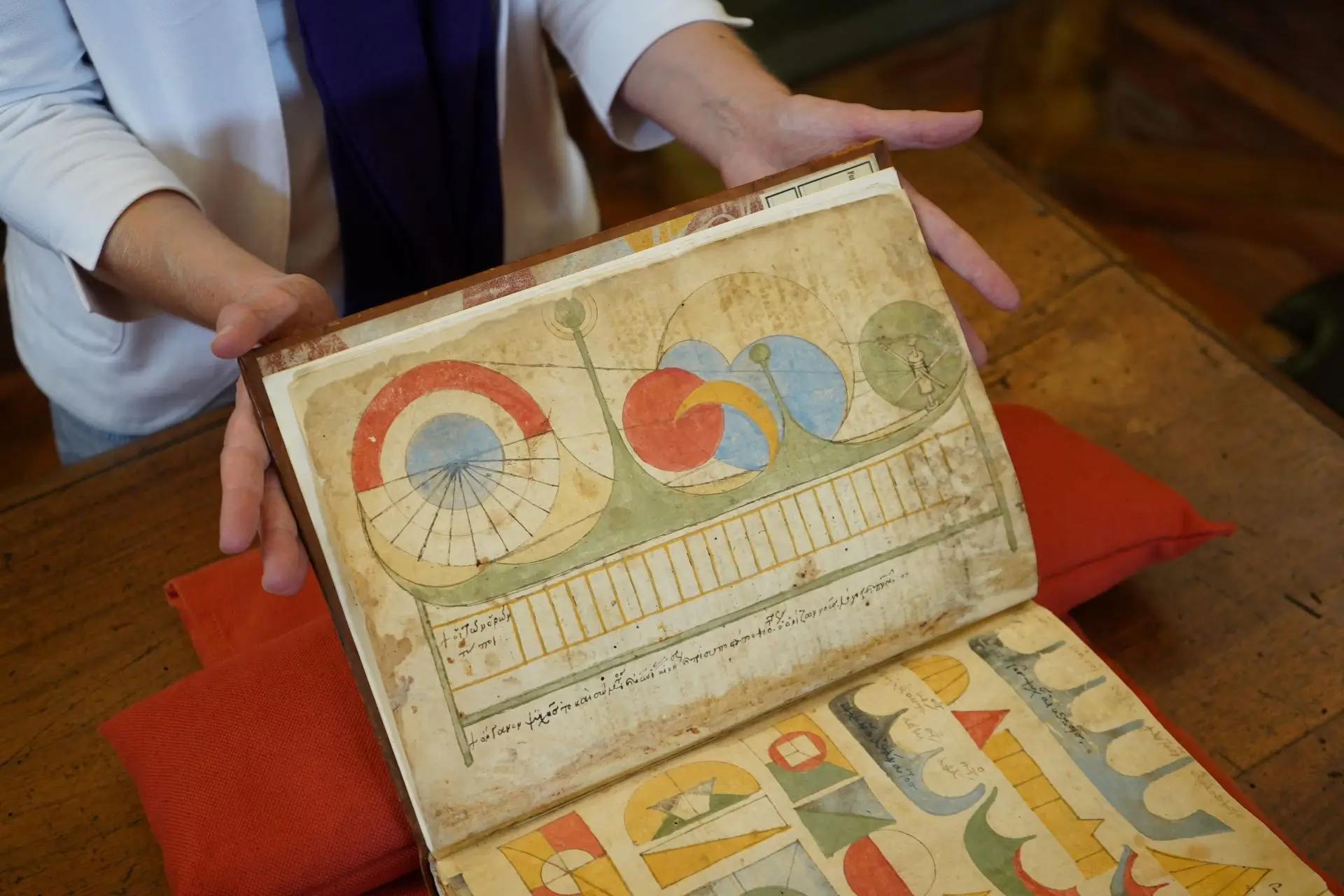
Also noteworthy is the splendid fifteenth-century Ptolemy (Gr. Z. 388 = 333), for which a facsimile edition has been produced.
The inventories
The inventories of the donation—covering the volumes as originally stored in crates and subsequently housed in the Library of St Mark—have been published by Lotte Labowsky in Bessarion’s Library and the Biblioteca Marciana: Six Early Inventories (Rome, Edizioni di Storia e Letteratura, 1979).
Further reading
- Bessarione e l’Umanesimo, exhibition catalogue, Venice, Biblioteca Nazionale Marciana, edited by Gianfranco Fiaccadori; Naples, Vivarium, 1994.