

The sansovino library building
Construction of the building intended to house Cardinal Bessarion’s book collection—destined to become the public library of the Venetian Republic and to accommodate the offices of the Procurators of St Mark—began in 1537 under the direction of Jacopo Sansovino (Florence, 1486 – Venice, 1570).
The building formed the cornerstone of the urban renewal programme promoted by the Florentine architect, who in 1529 had been appointed proto of the Procurators—that is, superintendent of many of the buildings overlooking St Mark’s Square.
Sansovino began construction of the Library from the corner near the bell tower, clearing the area of market stalls and inns and creating a unified architectural front of great formal elegance.
This intervention was intended to allow the southern side of the Piazzetta to stand in dignified dialogue with the Doge’s Palace opposite.
Sansovino introduced stylistic features that were innovative in the Venetian context, drawing inspiration from Roman models. The Library presents itself as a continuous loggia resting on a ground-floor portico. The lower level is articulated by Doric arches surmounted by an entablature with alternating triglyphs and metopes. The upper loggia, in the Ionic order, is enriched by a frieze decorated with putti and garlands of flowers and fruit.
The composition is crowned by a balustrade punctuated by three obelisks at the corners and by a series of statues of classical deities executed by Alessandro Vittoria and other prominent artists.
Sansovino’s original design envisaged a vaulted roof. However, its collapse in December 1545—when construction was already well advanced—led to his temporary imprisonment and to his being held financially responsible for the reconstruction. The project was subsequently modified, and a large terrace was built in place of the vault.
Between 1537 and 1553, Sansovino completed the first sixteen bays of the Library. In 1588, Vincenzo Scamozzi continued the work, demolishing the Palazzo delle Beccherie and constructing the final five bays extending towards the Molo (the waterfront quay beside St Mark’s Square).
Click to view the image in high definition
Staircase and Vestibule
The entrance portal, at no. 13/A, is flanked by two caryatids by Alessandro Vittoria, installed between 1553 and 1555.
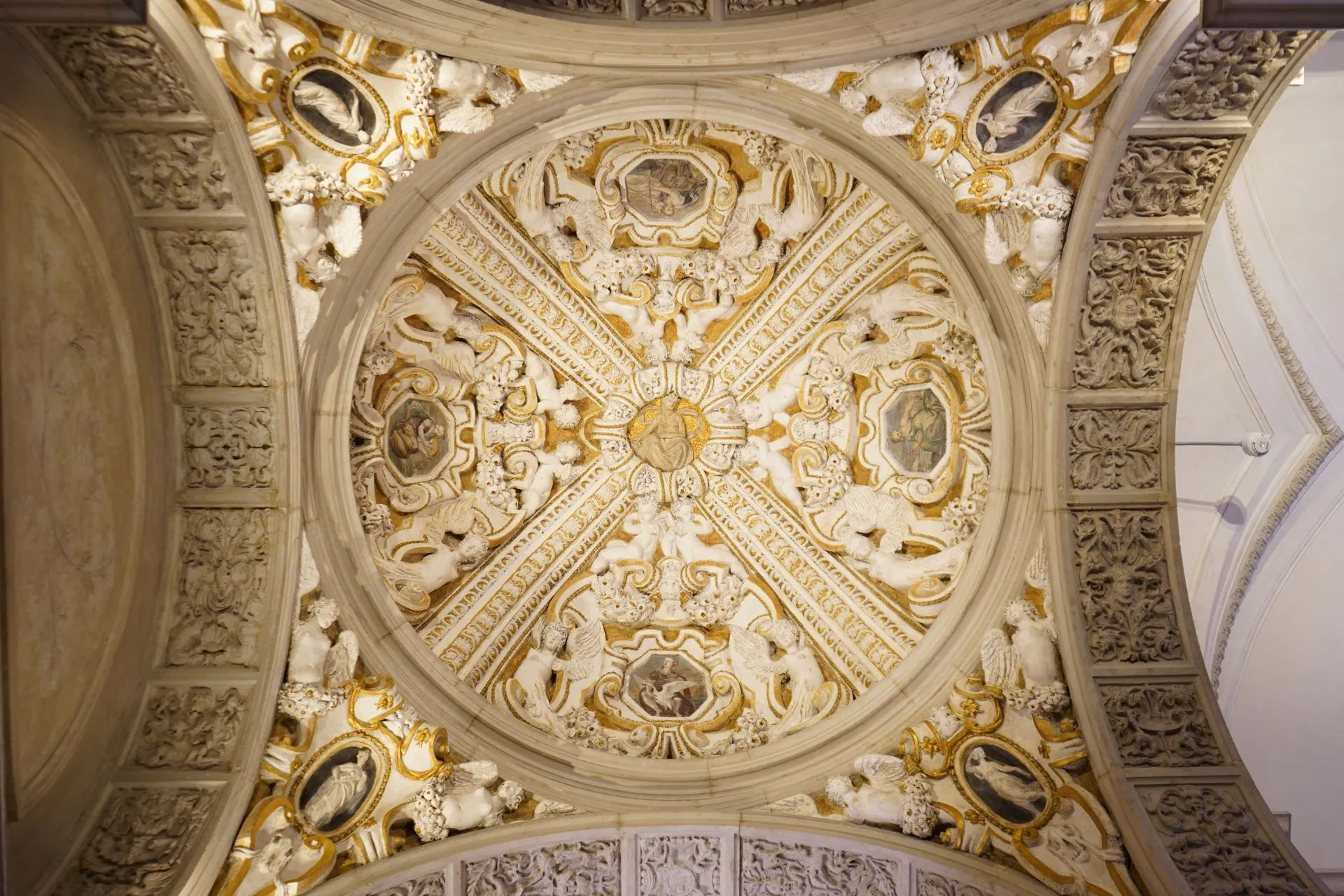
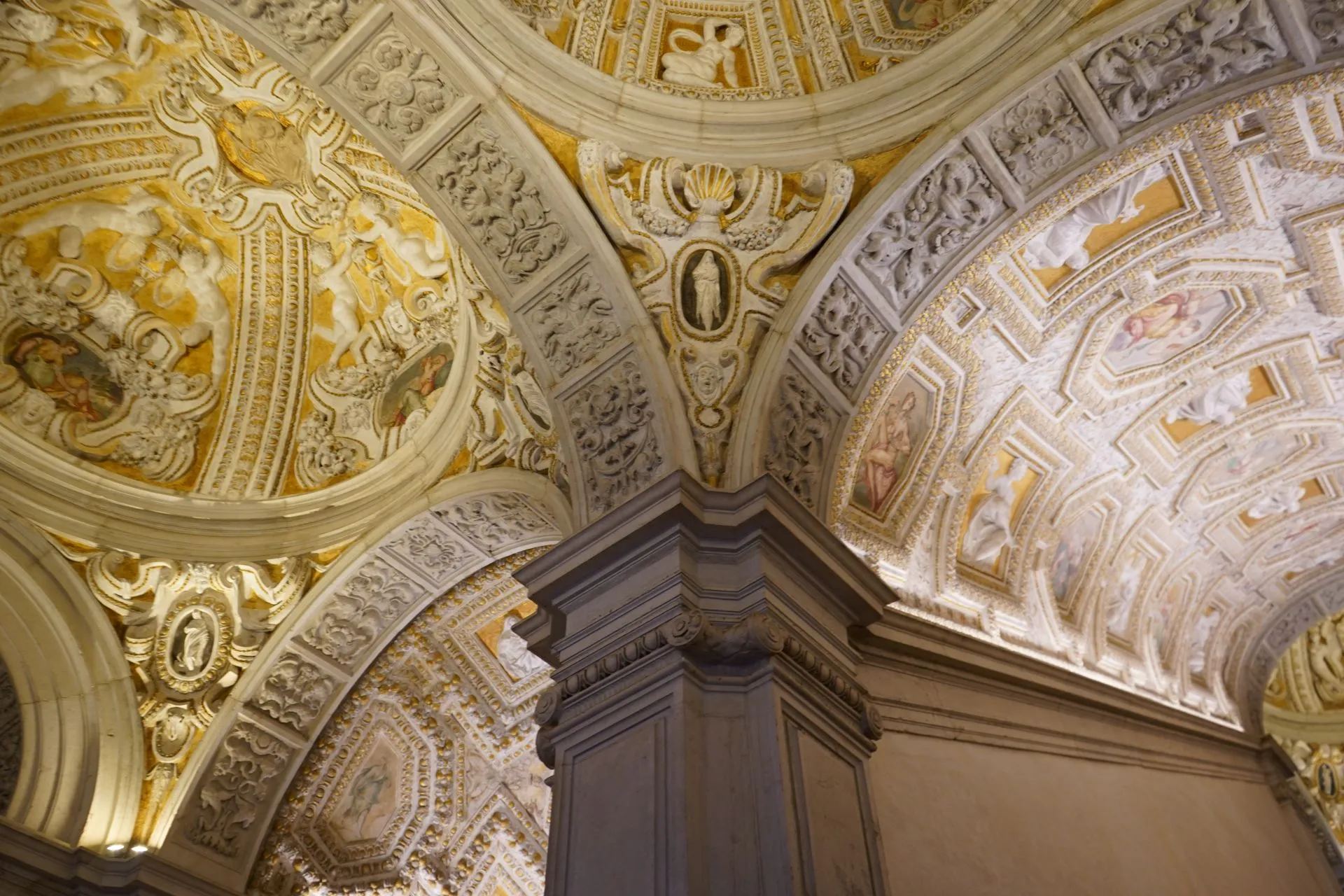
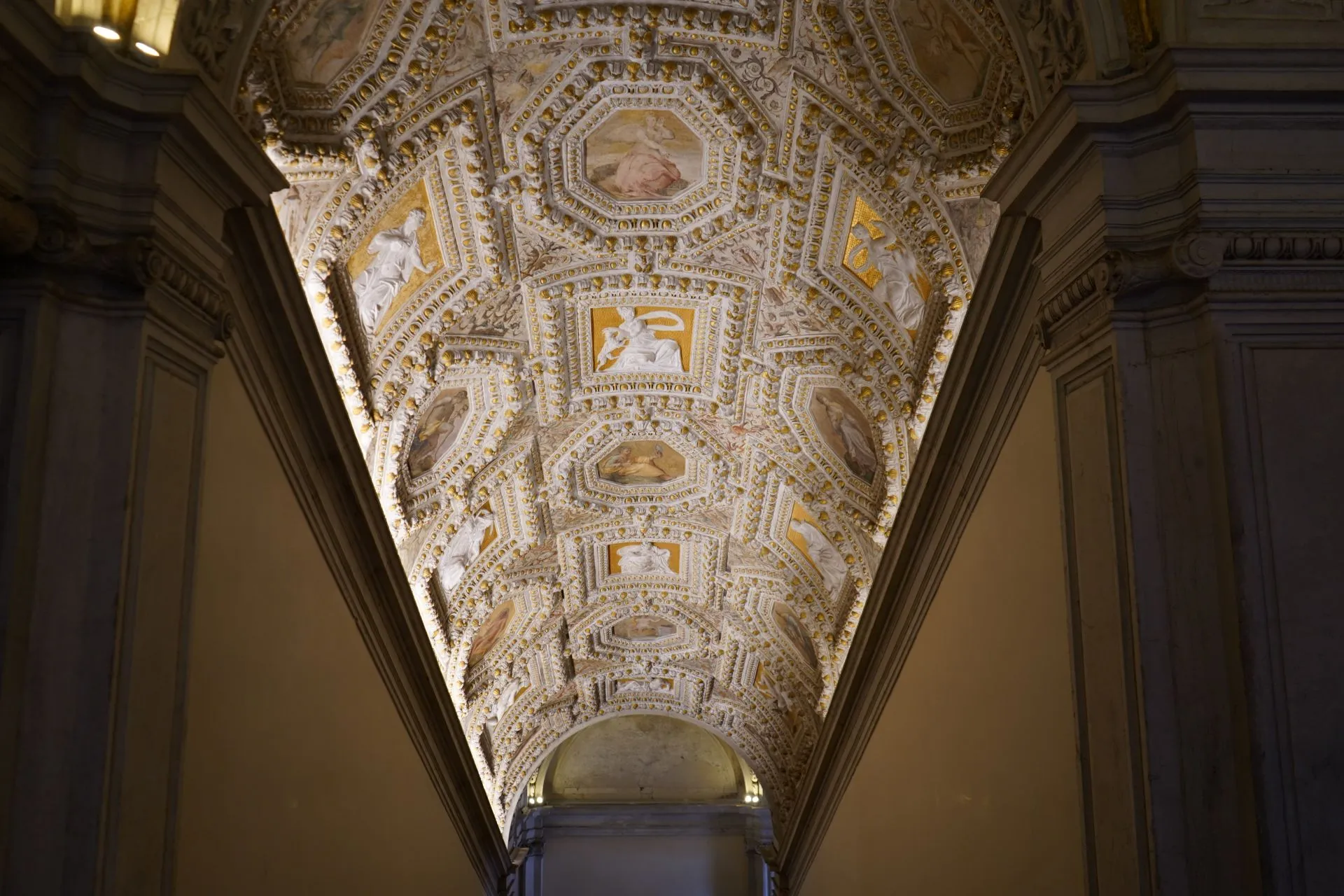
Beyond the portal rises a double staircase with domed landings and vaulted ceilings. The decoration consists of stuccoes by Vittoria and painted panels: Battista Franco executed the compartments of the first flight, while Battista del Moro decorated the second.
The iconographic programme alludes to a spiritual ascent from a Neoplatonic perspective: on the first flight, man—conditioned by the planets and the elements—begins his ascent; on the second, he attains wisdom through the exercise of virtue. This culmination is most clearly expressed in Vittoria’s stucco at the summit of the decorative cycle, representing a female figure holding a book and a circle, the latter symbolising eternity.
Along the staircase stand six ancient Roman columns in rare marbles, originating from the Basilica of Santa Maria in Cannedolo (Pola).
The dome above is enriched with stuccoes and painted panels depicting musical themes, an allusion to cosmic harmony.
The staircase leads to the Vestibule, or Antechamber, where the theme of wisdom is further emphasised by Titian’s painting La Sapienza (Wisdom, 1560). The canvas is set into the ceiling within an elaborate trompe-l’œil architectural framework executed by Cristoforo and Stefano Rosa, which reproduces a complex loggia articulated by columns and balustrades, creating a striking impression of spatial depth.
Conceived by Sansovino and his patrons as the seat of the University of San Marco, the Vestibule was originally adorned with portraits of the Procurators and painted lunettes, to which Jacopo Tintoretto also contributed. When, between 1591 and 1595, the space was transformed into the Statuary Museum of the Republic following the donation of Cardinal Grimani’s collection, the original pictorial cycle was dispersed.
Vincenzo Scamozzi subsequently redesigned the walls of the Vestibule—still visible today—by introducing niches, pilasters, pediments, and cornices, thereby creating an antique architectural setting appropriate for the display of Greek and Roman statues.
Click to view the image in high definition
The hall
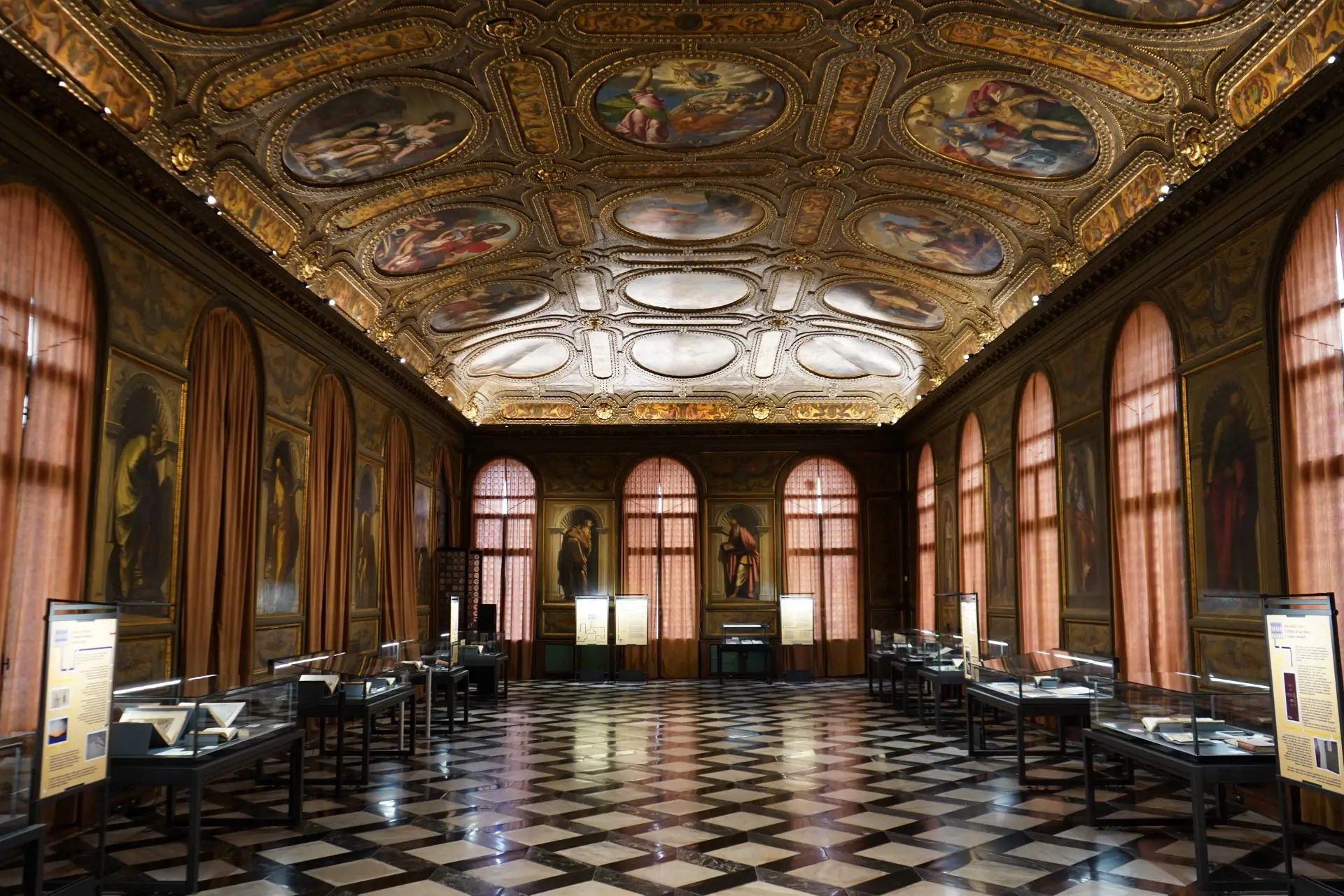
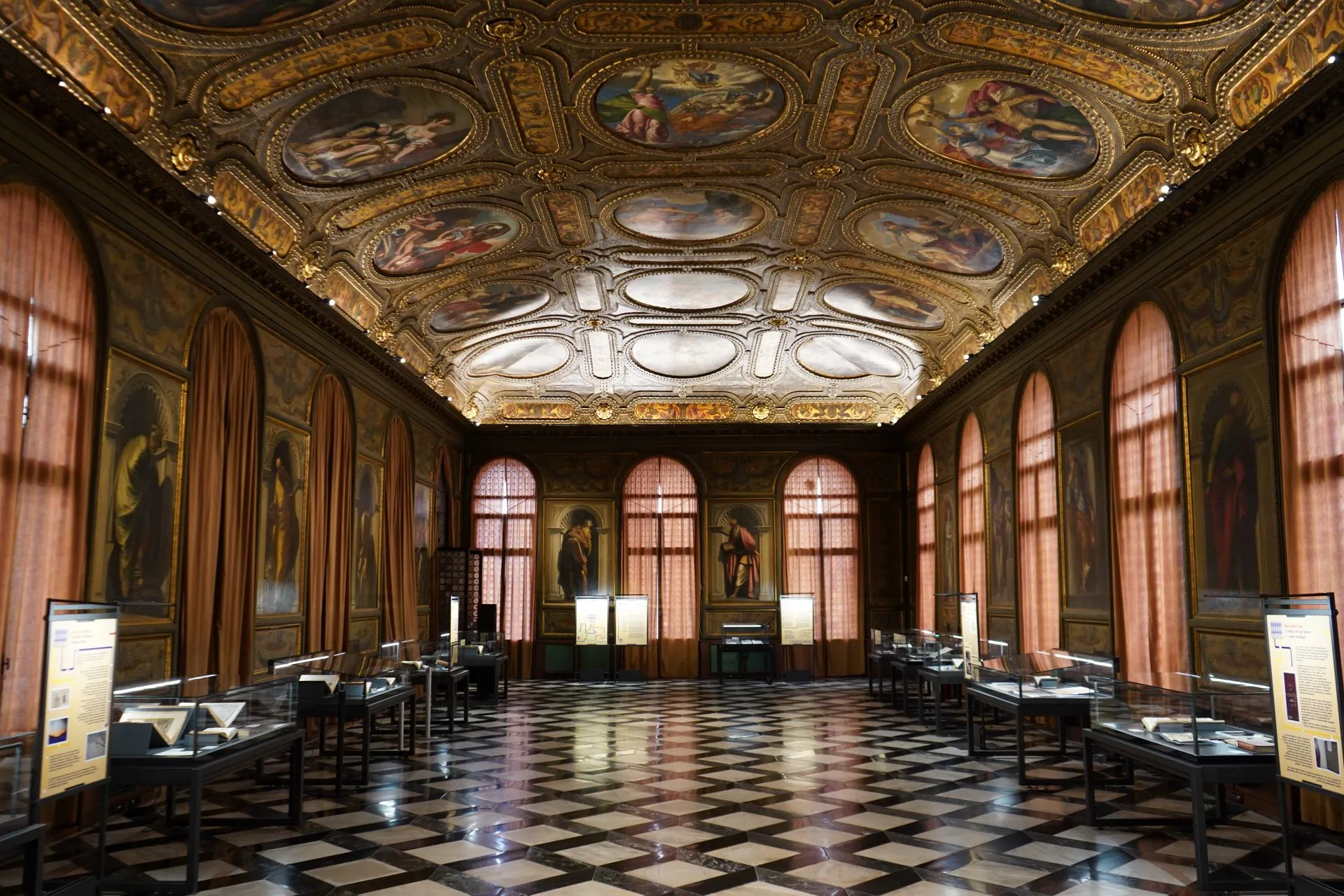
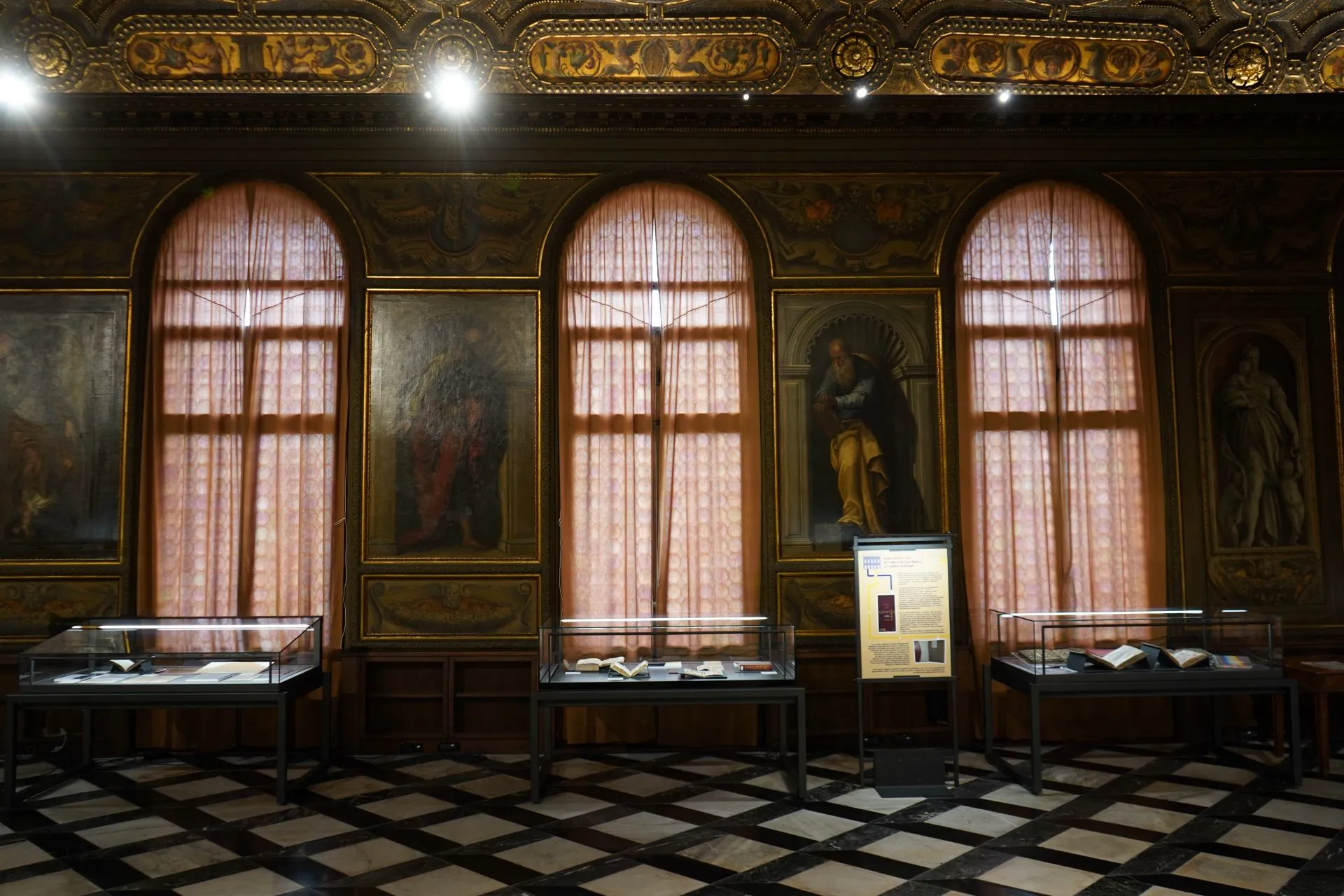
Dal Vestibule, visitors access the Library Hall through a noble portal, the true place of books, built specifically to house Cardinal Bessarione’s library collection.
The volumes were initially placed in walnut wooden benches and mostly chained to them. Later, cabinets placed along the walls increased the space for book storage.
For the library, the Procurators of San Marco, also following the advice of Aretino, Titian, and the circle of the influential Grimani family, chose to create two important decorative cycles:
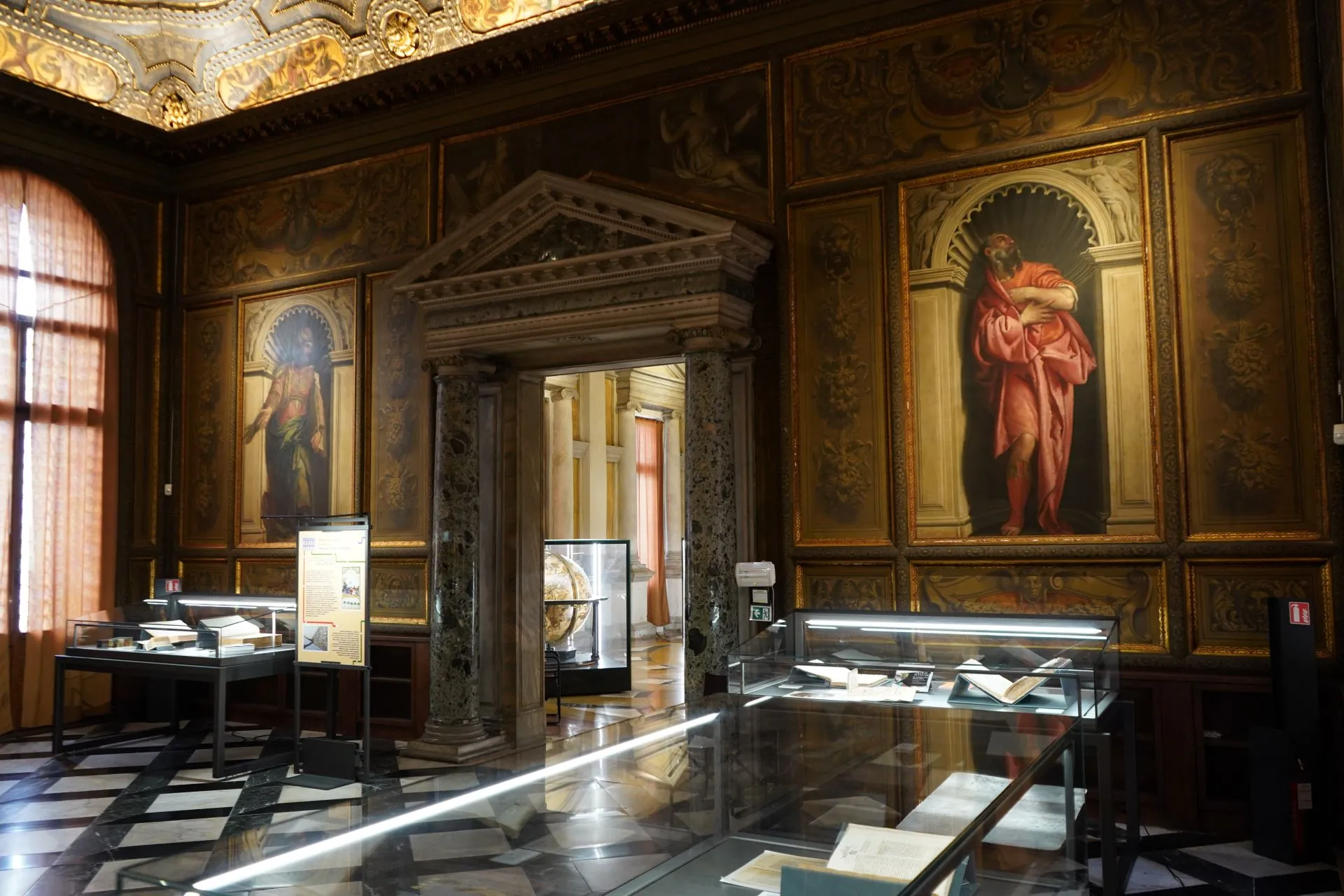
- that of the walls, which included some portraits of Philosophers, by Paolo Veronese, Jacopo Tintoretto, and others;
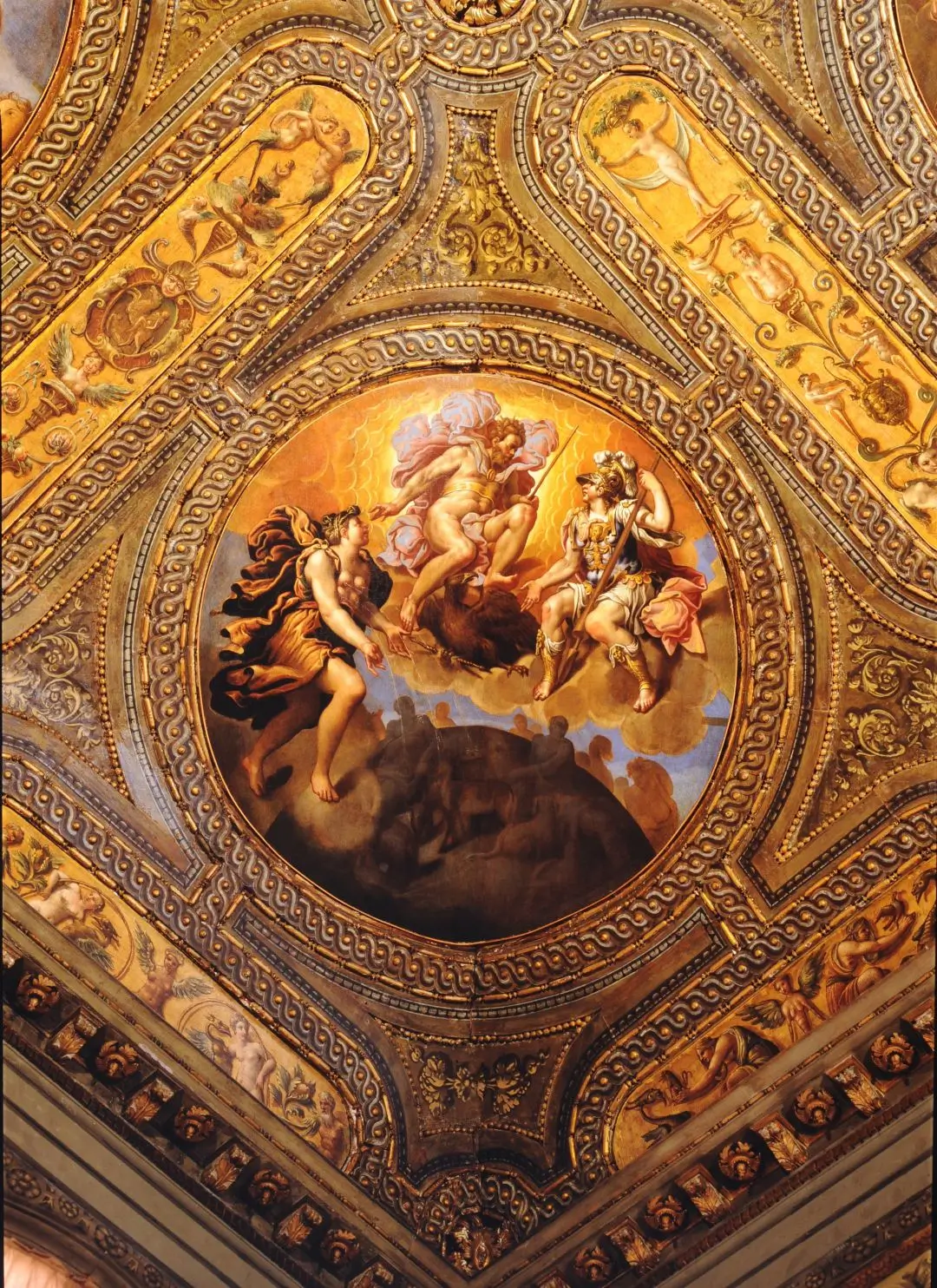
- that of the ceiling, composed of 21 roundels, entrusted to Andrea Schiavone, Paolo Veronese, Battista Zelotti, Giulio Licinio, Battista Franco, Giuseppe Salviati, Giovanni De Mio.
While the staircase iconography was dedicated to wisdom and contemplative life, the themes addressed by the artists contributing to the ceiling decoration concerned active life: the knowledge preserved in the Library space was intended to be used to concretely work for the public good.
In the vaulted ceiling, 52 grotesque panels by Battista Franco were also placed.
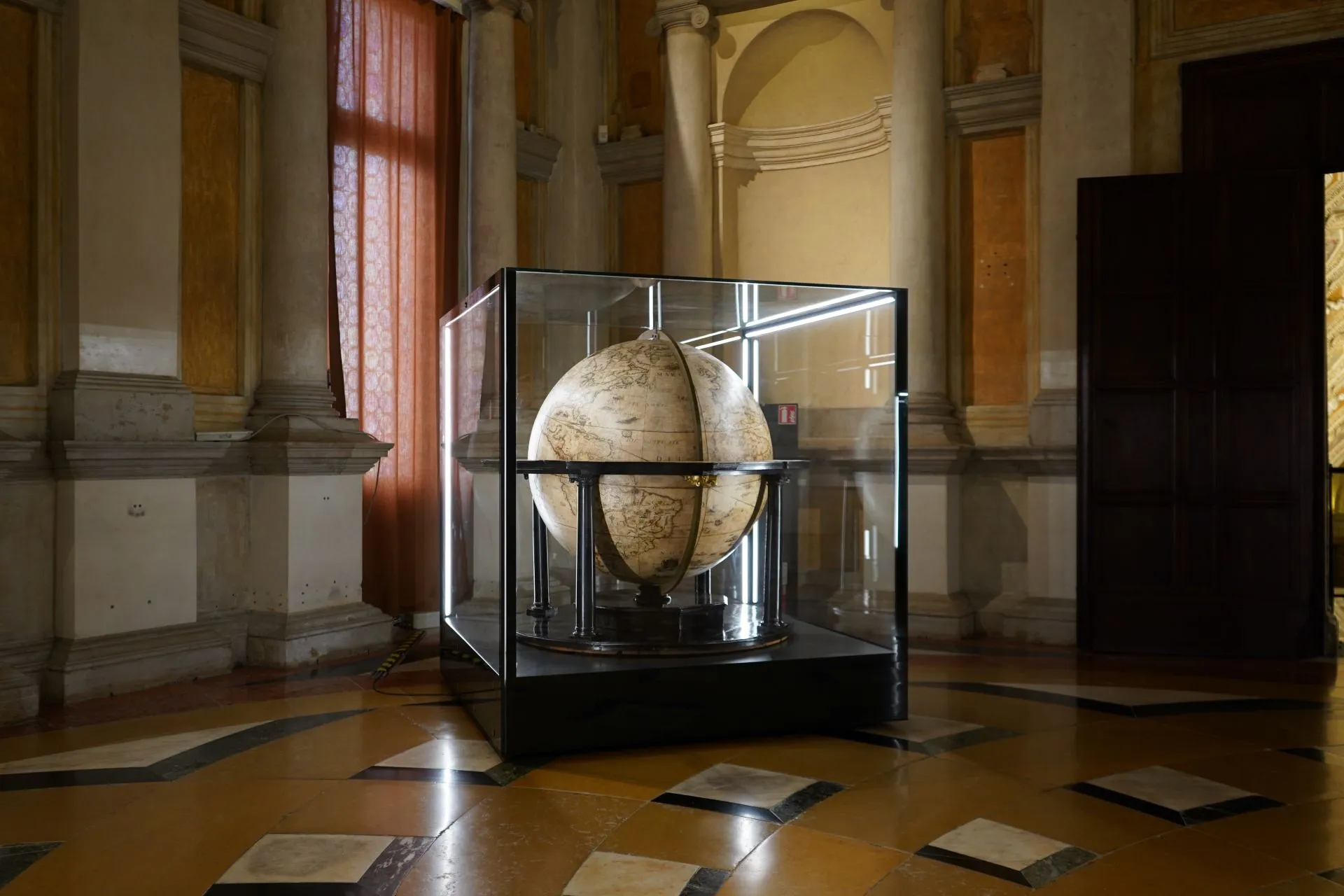
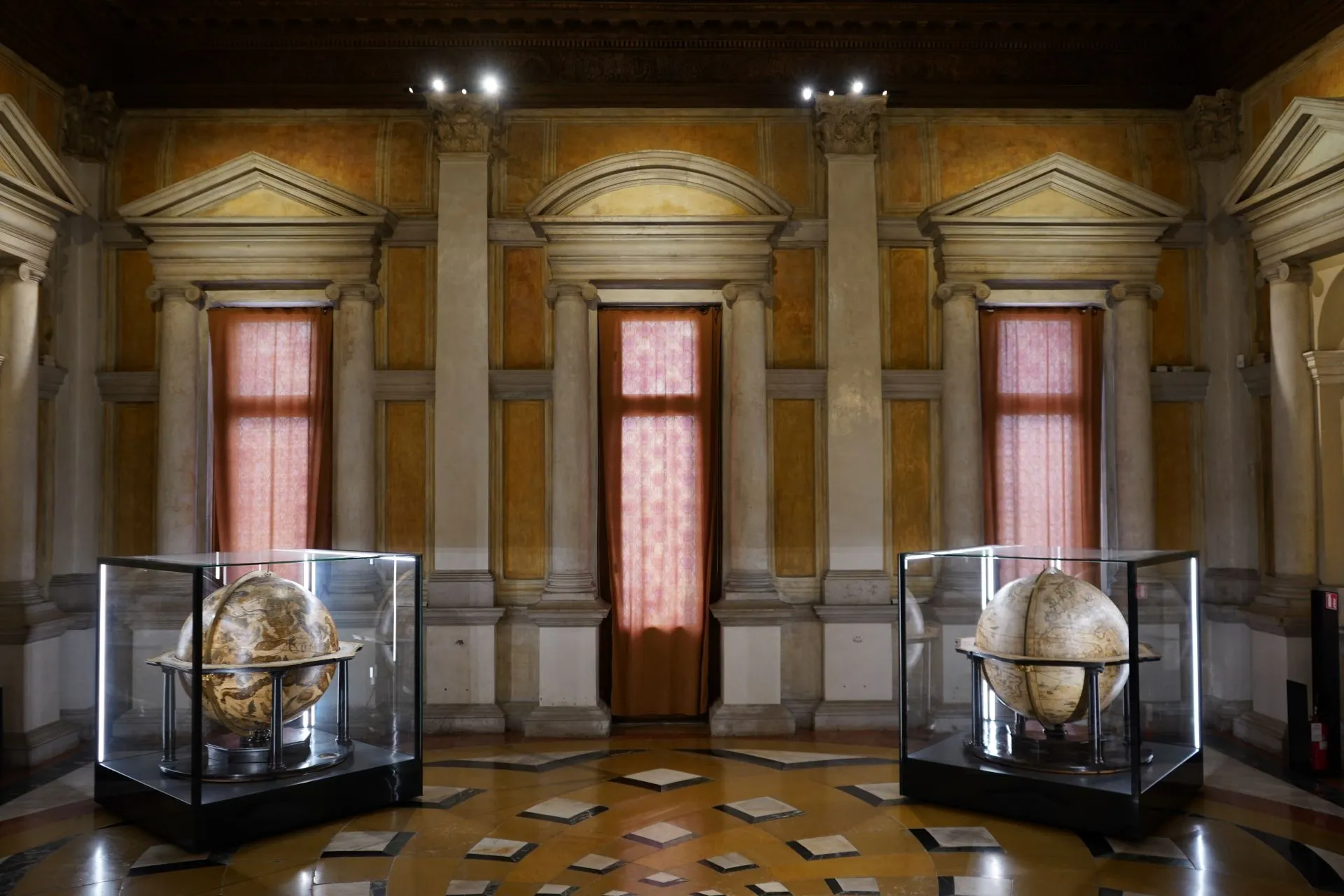
At the center of the Sansovian Hall are now two globes by Vincenzo Coronelli: a terrestrial globe (Venice 1688, diameter 108 cm) and a celestial globe (Venice–Paris 1688–89, diameter 108 cm).
During the Library’s history, the need to make space for the increasing number of books and for the construction of new and taller wall shelving first led to reducing the number of philosopher paintings, and then, in 1763, relocating them to the Doge’s Palace.
Under French rule, the Library and the Statuary were transferred to the Doge’s Palace by royal decree of August 29, 1811.
In the Hall, intended as a reception space, two paintings by Jacopo Tintoretto were placed beside the entrance door, The Theft of the Body of Saint Mark, and Saint Mark Saves a Saracen from Shipwreck, from the Scuola Grande di San Marco.
On the left side wall a large painting by Antonio Molinari (1655–1704), *David Precedes the Ark*, was placed, while opposite the entrance door, *Saul Offering a Sacrifice*, by the same painter.
In 1924, the Library, which since 1904 had been installed in the former Venetian State Mint, also regained the Sansovian Library, inaugurated in 1929 after three years of restoration, in which the philosopher paintings were repositioned, removing the works by Molinari and Tintoretto.
The empty spaces were decorated by the painter Giovanni Costantini. A permanent exhibition of relics and rare items was set up in the hall.
From the 1980s onward, and continuing in the following years, the Sansovian Staircase and the Library paintings have undergone conservation restorations.
Since 1999, the Monumental Rooms of the Biblioteca Nazionale Marciana have been part of the integrated route of the Museums of Piazza San Marco.
Click to view the image in high definition
The procurators’ rooms
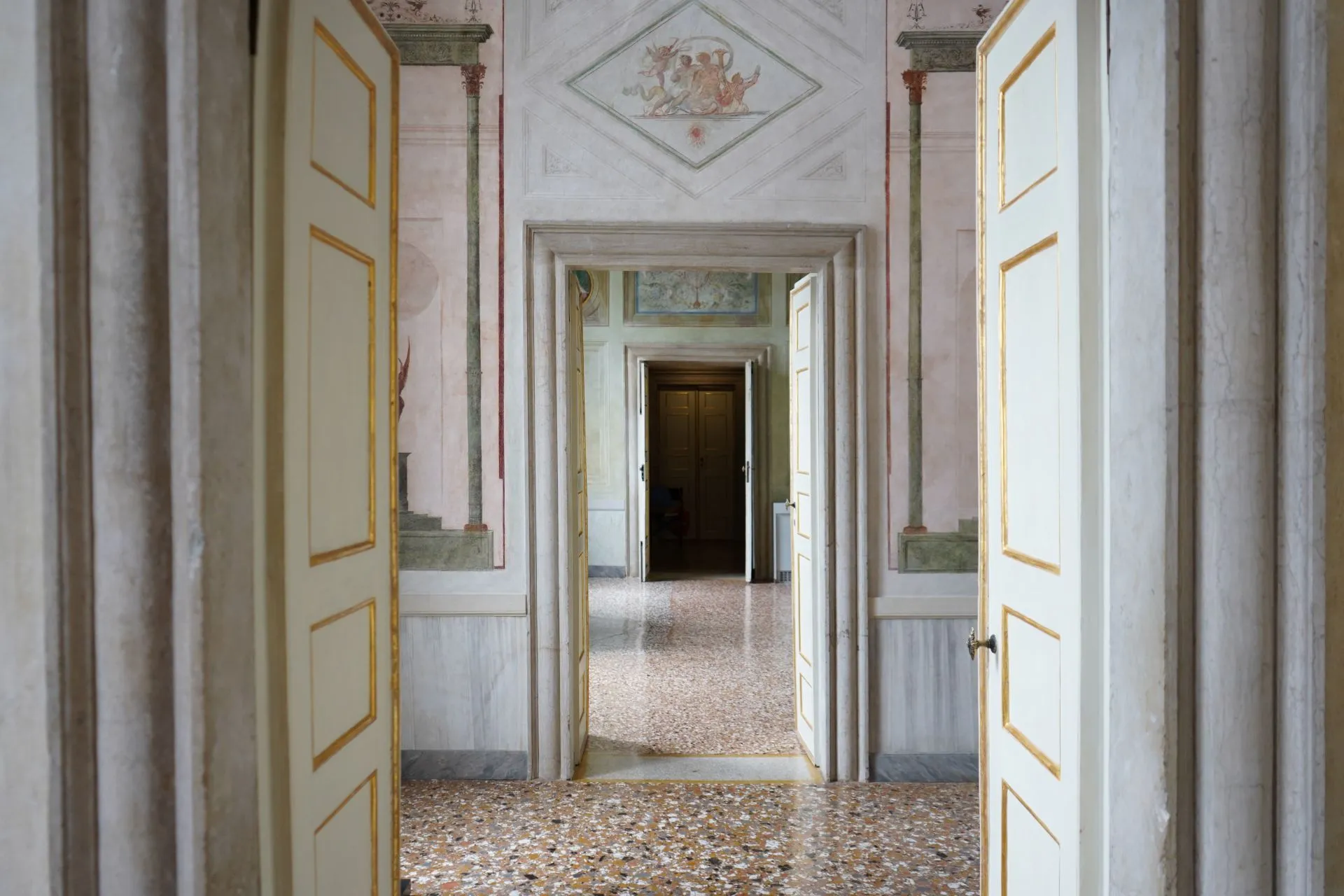
The other rooms of the Library building, those designed by Scamozzi, were intended to house the “ridotti” of the Procurators of San Marco.
They were accessed through a door on the level of the Vestibule entrance, leading to a group of three rooms made available to the *Procuratori de supra*, who oversaw the administration of the Basilica of San Marco.
The first room stored books and documents, the second was used by the staff serving the Procurators, and the third was intended for magistrates’ meetings.
This room opened onto a space leading to the area of the *Procuratia de citra* (citra, i.e., on this side of the Grand Canal), which handled charitable and testamentary matters for the sestieri of San Marco, Castello, and Cannaregio, also divided into three rooms facing the Piazzetta and the three *ridotti* of the *Procuratori de ultra*, across the canal, who were responsible for the sestieri of Dorsoduro, Santa Croce, and San Polo.
These offices were also reachable via a staircase that Scamozzi had inserted at the base of the first landing of the Library staircase, which is still in use today.
The rooms of the Procurators of San Marco, due to the prestige and importance of the office—unique in being a lifetime position besides that of the Doge—were richly decorated with portraits of doges, procurators, and other magistrates of the Republic, as well as paintings with other subjects, partly executed by Jacopo Tintoretto.
Unfortunately, at the end of the Republic, during the adaptation of the building as the seat of the Deputation of the Casa Patria and especially when the rooms were cleared to make space for Napoleon Bonaparte and his viceroy Eugène de Beauharnais, both the furnishings and the numerous paintings were dispersed.
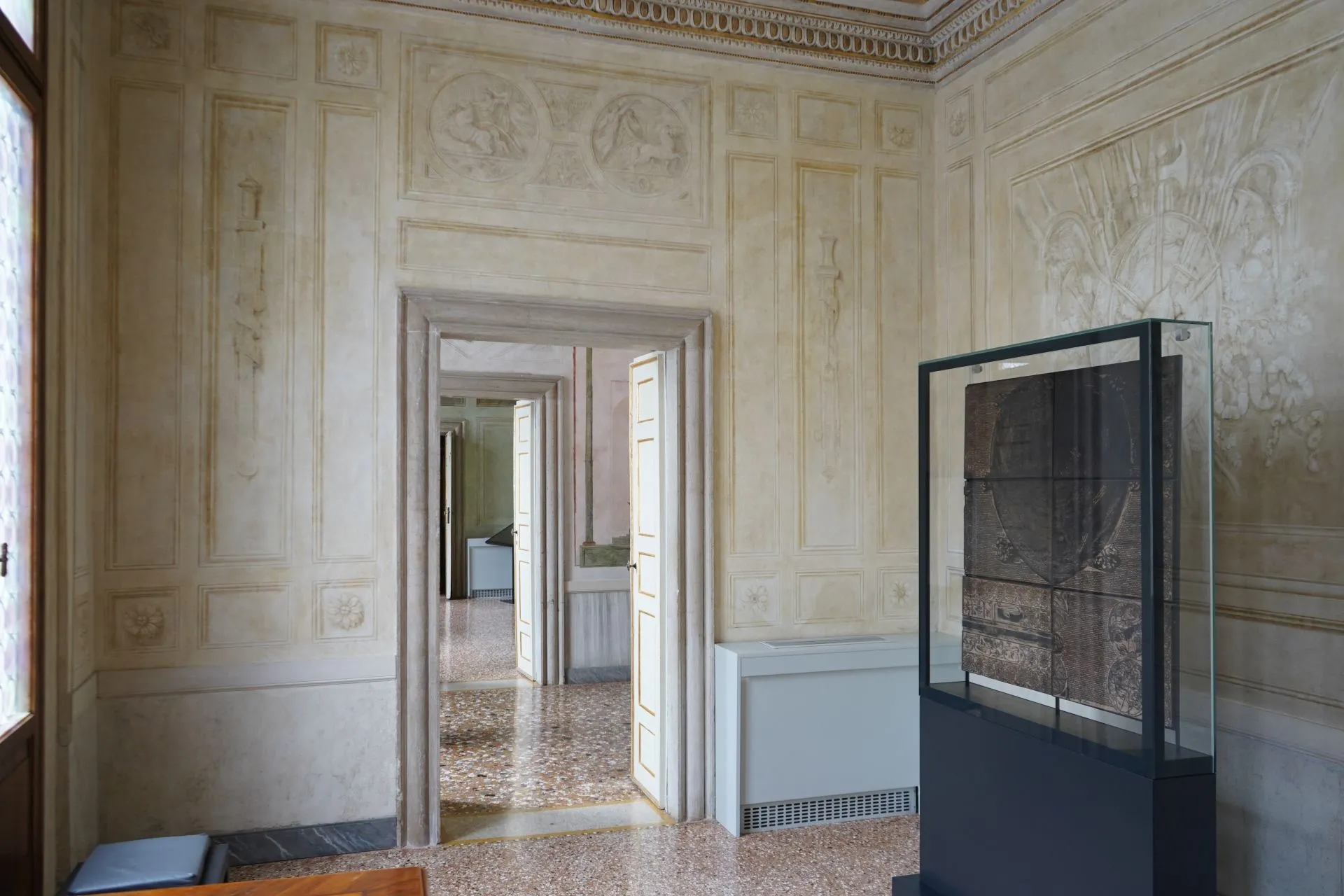
The rooms of the Procurators, together with the Procuratie Nuove, were entrusted to the architect and “Director of the Royal Palace Works” Giannantonio Antolini and integrated, along with the Vestibule and the Library, into the royal apartment.
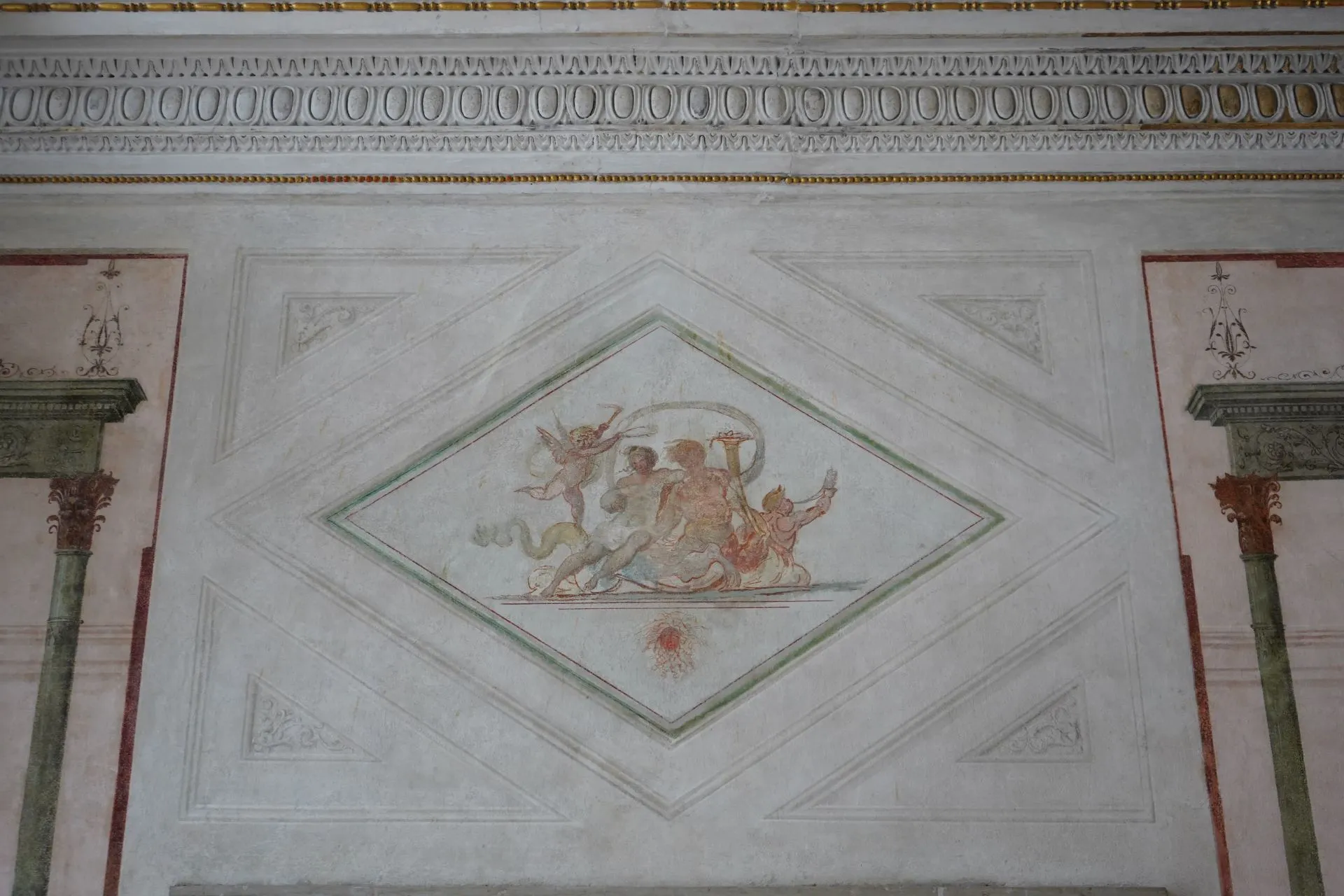
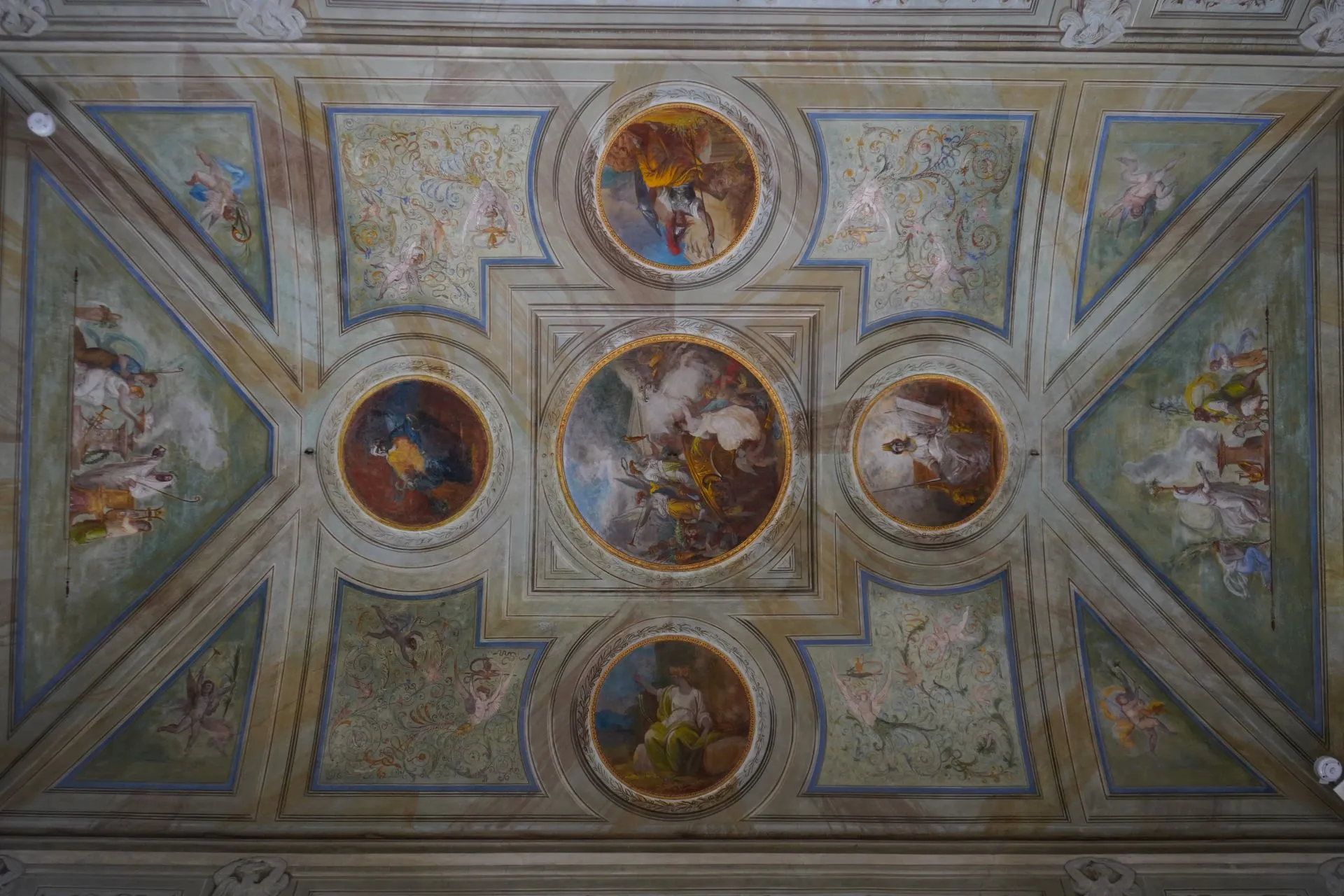
Felice Giani and Gaetano Bertolani were commissioned to create, between the summer and autumn of 1807, the series of neoclassical frescoes that still decorate the ceilings of what were the Procurators’ *ridotti*. The walls were originally covered with green tapestry, later removed with the return of the Austrians.