
The statuary museum of the republic
In 1587, Giovanni Grimani, Patriarch of Aquileia, resolved to donate his collection of antiquities to the Venetian Republic. It was one of the most important collections in Europe, distinguished in particular by the Patriarch’s preference for Greek originals rather than Hellenistic copies.
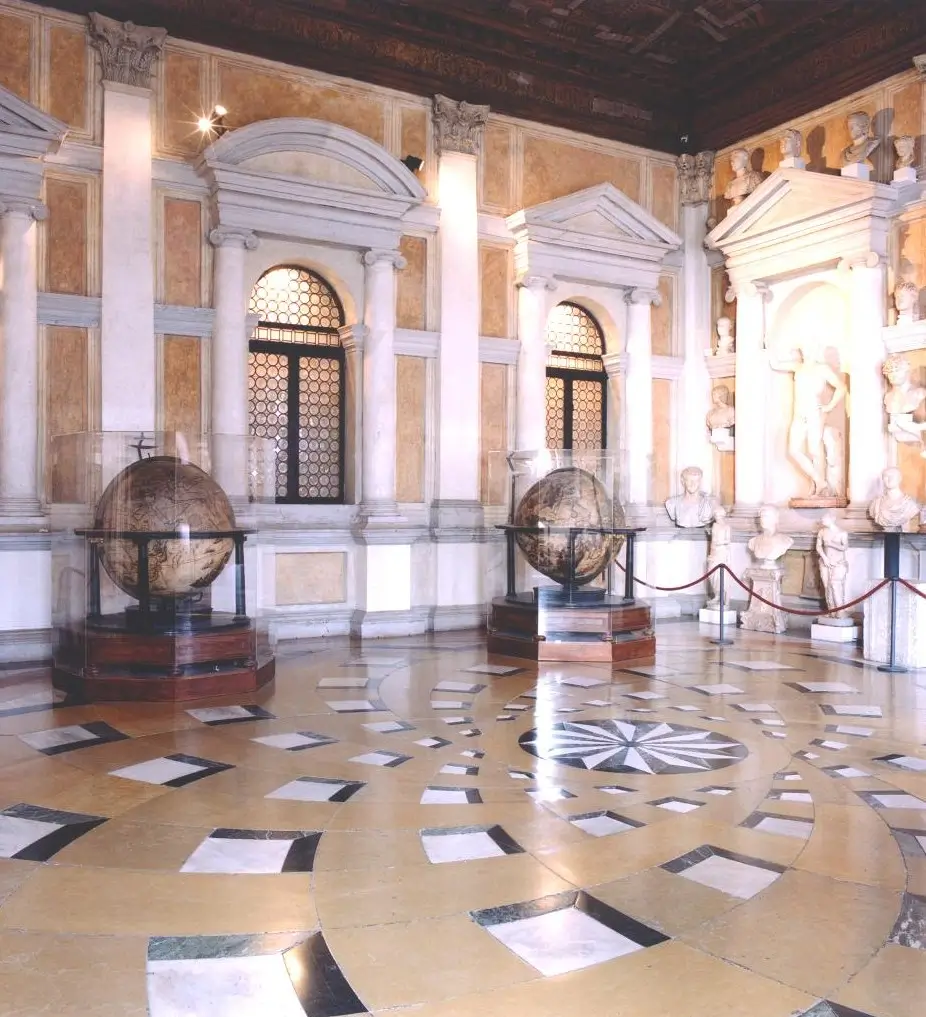
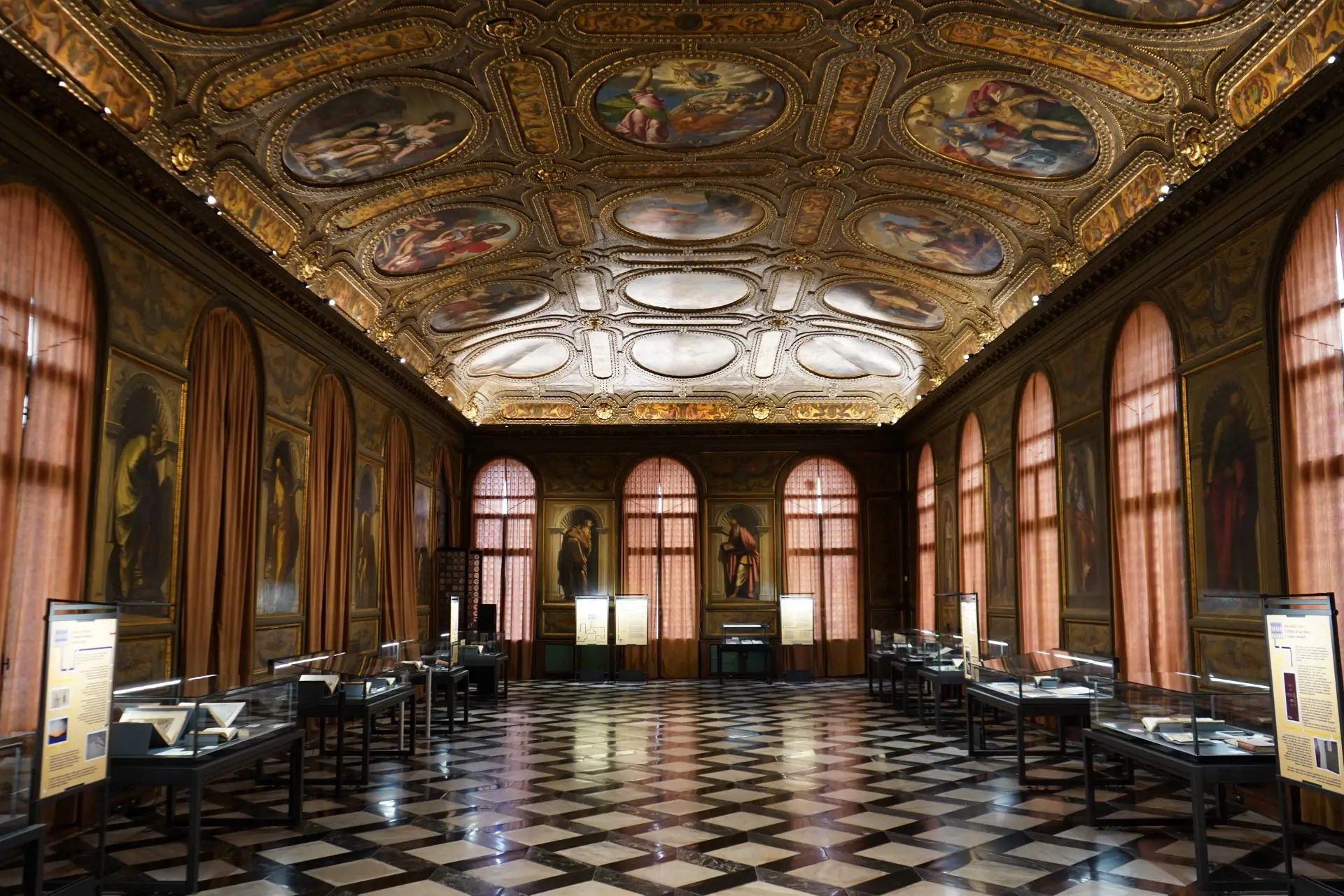
The Library’s Vestibule was chosen to house the precious collection and was accordingly transformed—on the basis of a design devised by the Patriarch himself in collaboration with Vincenzo Scamozzi—into the Statuary Museum of the Republic.
The marbles assembled by the Patriarch, together with those bequeathed to the Republic in 1523 by his uncle, Cardinal Domenico Grimani, were installed there. The ensemble comprised approximately 200 pieces, including numerous Greek originals, arranged in a dense and scenographic display conceived by Scamozzi and Giovanni Grimani so as to evoke an environment imbued with classical grandeur.
The installation was supervised by the Procurator of St Mark, Federico Contarini, who added a further seventeen marbles from his own collection to complete the arrangement.
Inaugurated in 1596, the Statuario was one of the earliest public museums in Europe. It remained under the authority of the Procurators until a Senate decree of 1636 placed it under the supervision of the Librarian and the Custodian.
Expanded over subsequent decades through additional donations, the Statuario was visited by a long succession of scholars and distinguished travellers, from Thomas Coryat and Bernard de Montfaucon to Charles de Brosses and Johann Joachim Winckelmann.
The refined drawings by Anton Maria Zanetti the Younger, who documented the collection in the eighteenth century in Representation in Drawing of the Four Facades and Isolated Pedestals of the Library (Cod. It. IV, 123 = 10040) and Drawings of Statues, Busts, and Other Ancient Marbles (Cod. It. IV, 65 = 5068), preserve the appearance of the room at that time.
The importance of the presence of ancient sculpture in Venice is further attested by the renown of the artists who, over the two centuries of the Statuario’s existence, were involved in restoring its marbles (from Tiziano Aspetti and Alessandro Vittoria to Antonio Canova and Giuseppe Volpato), as well as by those who drew inspiration from them (from Titian and Tintoretto to Canova).
Like the Library of St Mark, the Museum was transferred to the Doge’s Palace in 1811, leading to the dismantling of the Statuario. The marbles—augmented by subsequent bequests—remained dispersed throughout the Palace for decorative purposes until 1846, when they were reunited in the Doge’s apartments. In 1882, the administration of the marbles was formally separated from that of the Library’s books.
When the Royal Palace in the Procuratie Nuove was made available, several of its rooms, extending beyond the Sansovino Library, were designated as the site of the new museum.
Between 1923 and 1926, the Archaeological Museum of Venice was established in its present location on the first floor of the Procuratie Nuove, where the core of the Grimani collection is still preserved.
In 1997, the Biblioteca Nazionale Marciana, together with the National Archaeological Museum of Venice, organised an exhibition in the Monumental Halls entitled Lo statuario della Serenissima. Due secoli di collezionismo di antichità: 1596-1797, whose catalogue was edited by Irene Favaretto and Giovanna Ravagnan (Venice, 1997).