

The mint
Its functions
The Mint (Zecca), which had been relocated from the Rialto area to St Mark’s Square in 1277, was a crucial institution of the Venetian state, performing two fundamental functions within the Venetian economy: providing universally recognised currency in circulation—a basic prerequisite for the development of a mercantile society—and generating revenue for the state through its monetary activities. Gold coinage was, in fact, highly profitable: by 1285 it was already yielding the state a net profit of 2.2 per cent relative to the cost of raw materials.
The Mint also served as a depository for Venetian citizens and institutions. It thus performed the functions of a fully fledged bank, hence the proverbial expression “aver i schei in Zeca” (“to have one’s money in the Mint”), indicating the highest degree of financial security.
The Mint housed not only the workshops for the manufacture of coins, but also all the offices responsible for controlling the circulation of money, including:
- Office of the Provveditori sopra Ori e Monete (later Deputati sopra Ori e Monete), which monitored the valuation of gold in order to control—and, if necessary, intervene to regulate—the price of the metal and the value of coinage.
- Office of the Camerlenghi del Comun, which oversaw the collection of taxes and, in addition to its official headquarters at Rialto, maintained an office in the Mint.
- Office of the Depositary, which supervised the state “treasury” held at the Mint, as well as the safekeeping and management of deposits belonging to private citizens, private associations and religious institutions (orders, convents, etc.).
From the thirteenth century onwards, the Quarantia—a body of the Republic originally (1179) composed of the forty electors of the Doge—was responsible for overseeing the activities of the Mint. In the fourteenth century this responsibility passed to the Council of Ten, and in the sixteenth century specific offices were established to manage the various functions required for the governance of the Mint and the control of monetary policy.
The Venetian Mint continued to operate even after the fall of the Republic, albeit with reduced functions (such as the production of commemorative medals), until 1870.
In 1872 the building was designated as the headquarters of the Chamber of Commerce, and in 1904 it was finally assigned to the Biblioteca Nazionale Marciana.
The most famous Venetian coin: the gold ducat or zecchino
The best-known Venetian coin, issued from 1284 and initially called the ducato (from doge), was a gold coin with the same weight and fineness (the proportion of pure metal to alloy) as the Florentine florin. In the sixteenth century the gold ducato came to be known as the zecchino, a name derived from the fact that it was produced in the Mint.
Given its almost perfect purity (997/1000 gold), the coin also gave its name to pure gold, hence the term oro zecchino.
On the obverse of the coin, St Mark is shown presenting the banner to the kneeling Doge; on the reverse, Christ is depicted within an oval (mandorla) surrounded by nine stars.
The zecchino remained unchanged in form from its first issue under Doge Giovanni Dandolo (1284) to its last (1797), under Doge Lodovico Manin at the end of the Republic.
The layout
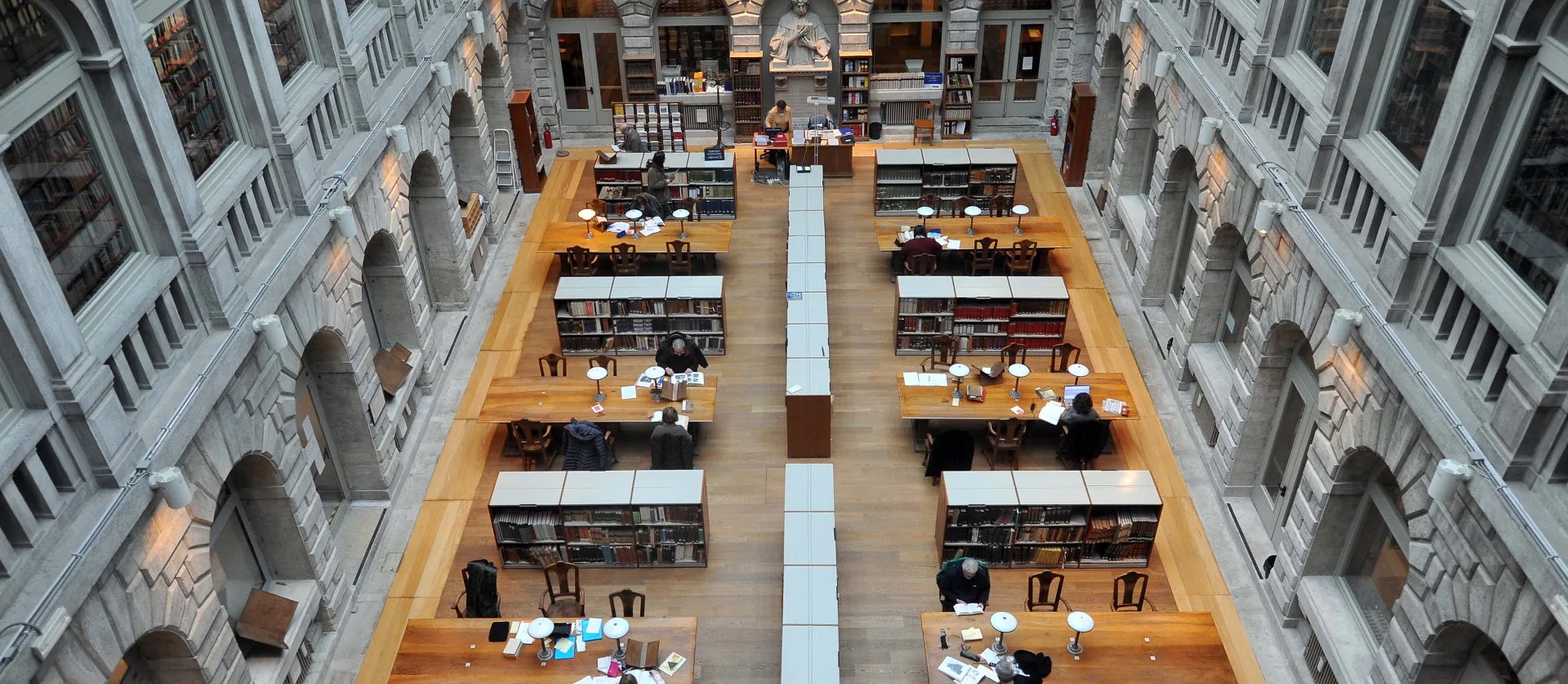
Upon passing through the entrance gate, the ground floor was arranged as follows: on the right were the workshops for coin production, while on the left, in the rooms overlooking the lagoon, were the storerooms and furnaces. All minting activities were organised around the courtyard.
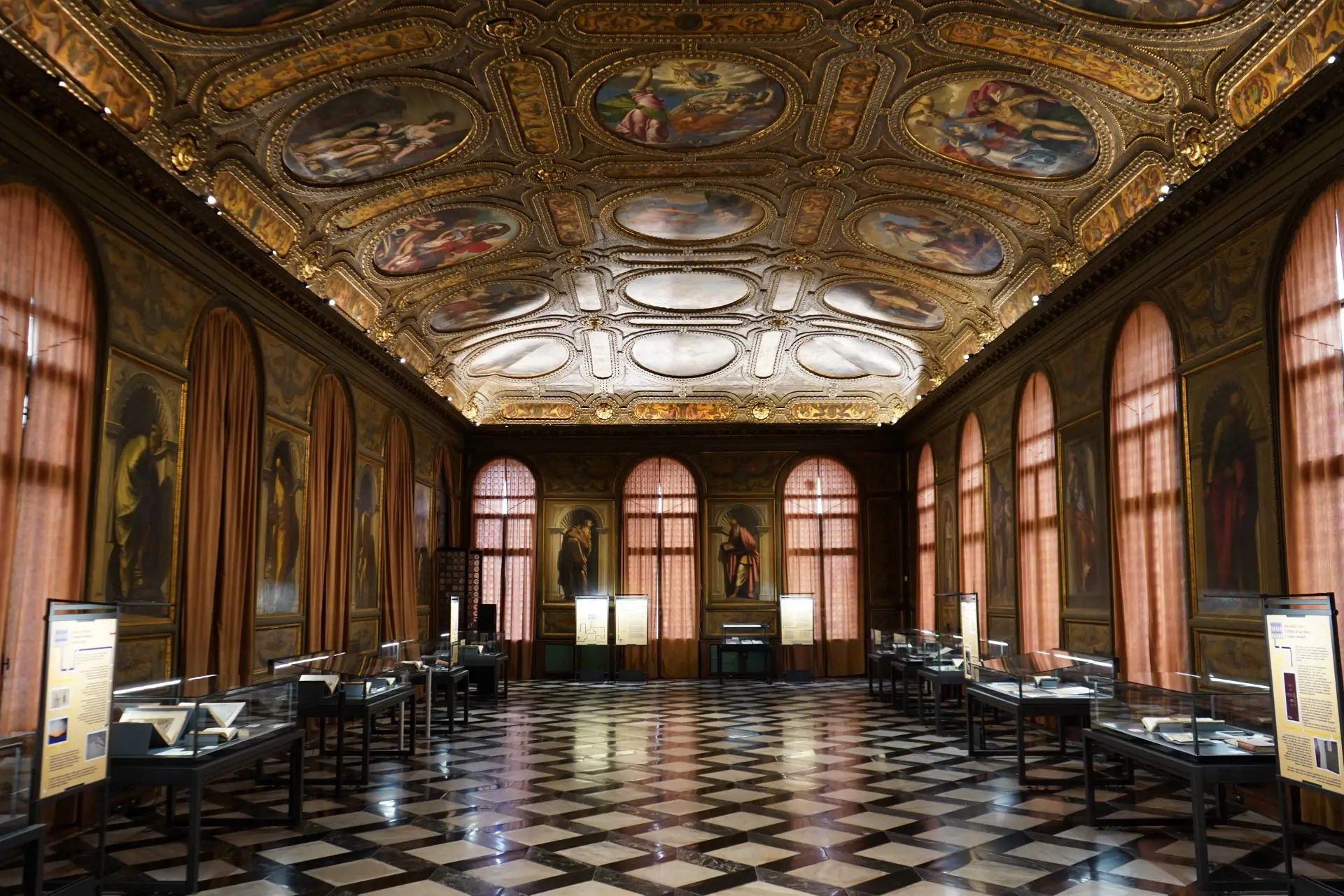
In particular, the foundry was located in what is now the ground-floor manuscript room, where metals were refined and then cooled.
Overlooking the courtyard were the various “workshops” that transformed ingots into coin blanks using a range of machines (rolling mills, presses, and furnaces), including:
- the workshop for producing coin blanks, equipped with a furnace and a large hand-operated wheel that powered the dies used to produce sheets from the ingots (corresponding to the present-day small room housing the terminals for consulting online catalogues);
- the workshop for polishing the coin blanks (corresponding to the first section of the current catalogue room);
- the workshop for edge-rounding the coins (corresponding to the second section of the catalogue room, behind the statue of Petrarch);
- the blacksmith’s workshop, with an adjoining furnace (now the office behind the catalogue area);
- the workshop for minting the coins.
Here work was carried out mechanically using lever presses, which over time replaced manual minting operations (now the inter-library loan office).
An example of such a press, dated 1756, is on display at the Information Desk.
Naturally, for practical reasons, the workshops were relocated several times over the years; the layout described here refers to the period around 1750.
The treasure chests
On the first floor, facing the lagoon, were the offices of the Master of the Mint, the cashier, the auditor, and other officials. On this floor, distributed across various rooms, were twelve chests used to store bars of precious metal, each bearing the name of an apostle.
Four of these chests are still preserved today inside the old cella of the Mint—also known as the “gold prison” or the “ingot deposit”—now referred to as the “Chamber of the Chests” (stanza degli scrigni).
This is a room enclosed by massive walls and vaulted ceilings built of blocks of Istrian stone: a veritable stone strongbox, accessed through a narrow metal door, within which the four large wooden chests, reinforced with iron bars, still preserve historical artefacts from the Library.
Three of these imposing chests still retain their intricate period locks (17th–18th centuries).
Further reading
- Alan M. Stahl, La Zecca di Venezia nell’età medioevale, Rome, Il Veltro, 2008
- Manuela Morresi, Jacopo Sansovino, Milan, Electa, [2000]
- Manfredo Tafuri, Jacopo Sansovino e l’architettura del ’500 a Venezia, photographs and design by Diego Birelli, Padua, Marsilio, 1969