

Biographical overview
1589: Melchiorre Guilandino of Marienburg (2,200 printed books)
Melchiorre Guilandino, also known as Melchior Wieland (born between 1519 and 1520 in Königsberg, East Prussia; died in Padua in December 1589), was a botanist, physician, and indefatigable traveller.
He travelled extensively through Sicily, Turkey, the Middle East, and Egypt in search of medicinal plants, under the protection of the Venetian ambassador to Constantinople, Marino Cavalli. In 1560, however, he was captured by pirates and was released only after the payment of a substantial ransom by his friend Gabriele Falloppio, the renowned Paduan anatomist.
In 1561, he was appointed prefect of the Botanical Garden of Padua and subsequently obtained the chair for the demonstration and teaching of medicinal plants (simples). His career was marked by a heated controversy with the older and more celebrated Pietro Andrea Mattioli, a dispute that also involved Konrad Gessner, who corresponded with both scholars.
The bequest
On 22 December 1589, Guilandino dictated his will, stipulating that all his printed books—many of them annotated—were to be delivered to the Library of St Mark. He was connected to the institution through his friendship with the then librarian, Benedetto Zorzi. The bequest, consisting of 2,200 printed volumes arranged in twenty-three boxes divided by subject and further organised by format, reached Venice on 10 January 1590.
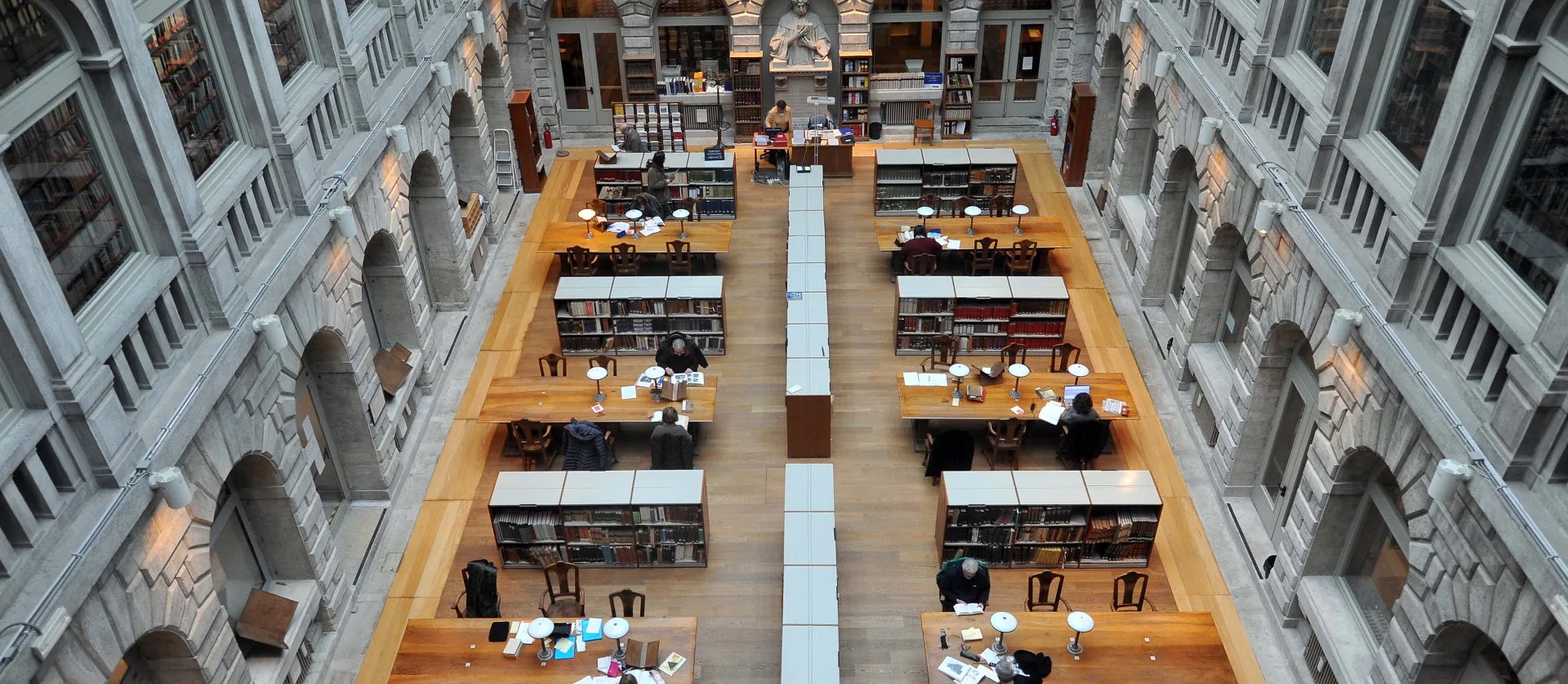
It was the first bequest to augment the Library of St Mark after its opening in the splendid Sansovinian premises.
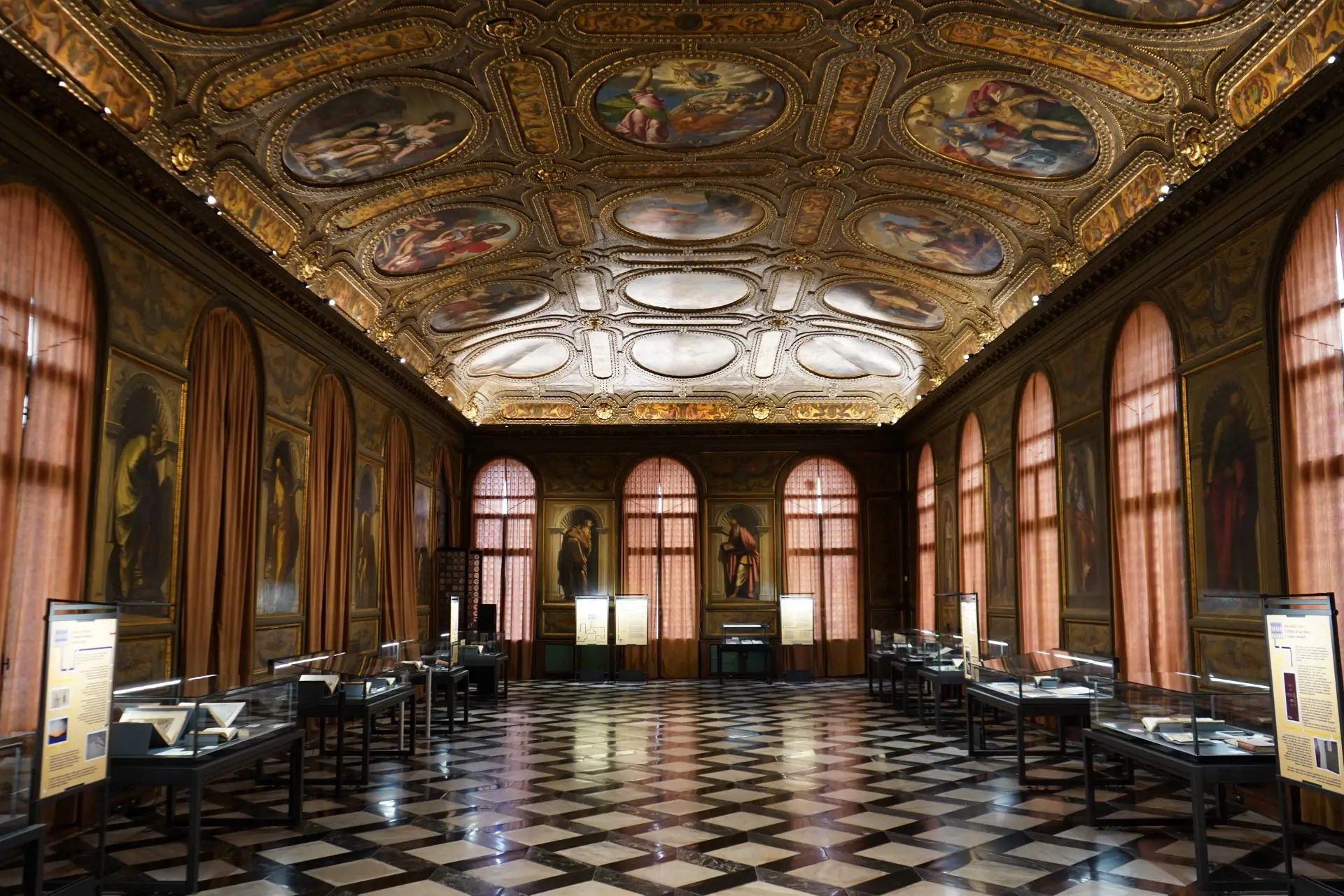
Guilandino had also set aside a substantial sum for the construction of cabinets and shelving to house his books. Accordingly, in 1591 the library hall—originally furnished with lecterns—was supplemented with seven cabinets of walnut and larch, installed in windows that had been closed during Vincenzo Scamozzi’s renovations.
Low cabinets were also placed beneath the painted figures of the philosophers.
Extent and composition
The inventory dated 2 January 1590, drawn up by Angiolo Saitta, chancellor of the podestà of Padua, records 2,115 entries corresponding to a significantly larger number of physical volumes. In the second box, relating to theology, for example, item no. 34 is described as “Biblia n. 2.”
Only the printed books were transferred to the Library of St Mark, while the manuscripts were left to his friend Benedetto Zorzi. The subjects represented in the bequest reflect Guilandino’s humanistic interests: alongside theology, there were boxes containing works on philosophy, grammar, history, studia humanitatis, medicine, botany, and mathematics.
Over time, Guilandino’s volumes were not preserved as a distinct collection but were incorporated into the Marciana holdings according to the Library’s customary subject classification.
Some of the most heavily annotated volumes were subsequently placed in the Manuscripts and Rare Books repository. Among these are a copy of Pliny’s Historiae mundi, printed in Basel by the Froben press in 1539 (now Cod. Lat. VI, 254 = 3067), and De plantis libri XVI by Andrea Cesalpino, printed in Florence by Marescotti in 1583 (now Raro 510).
Inventories and catalogues
The original inventory is preserved in the State Archives of Venice, Miscellanea di carte non appartenenti ad alcun archivio, b. 15 (2 January 1590).
Further reading
- E. Ferrari, “Le opere a stampa del Guilandino. Per un paragrafo dell’editoria scientifica padovana del pieno Cinquecento,” in Libri e stampatori in Padova, Padua, Tipografia del Seminario, 1959, pp. 377–463.