

The origins: fourteenth–sixteenth centuries
The idea of establishing a public library in Venice first took shape during the stay of Francesco Petrarca in the lagoon city. In 1362, he resolved to donate his books to the Republic so that they might form the nucleus of a larger collection accessible to scholars and lovers of learning.
In accepting the poet’s proposal, the Great Council outlined the costs required to provide a suitable space for the preservation of the books. Petrarch’s plan, however, was never realised.
A decisive turning point came in 1468 with the donation of the substantial and valuable library of the Greek cardinal Bessarion. The collection began arriving in Venice in 1469 and was housed in the Doge’s Palace. Governed by the Senate and entrusted to the care of the Procurators of St Mark, it gave concrete impetus to the long-standing idea of establishing a state library.
The project took concrete form only under Doge Andrea Gritti, within his broader programme for the renewal of the city. The construction of the Public Library building—intended to house Bessarion’s collection, future acquisitions, and the offices (ridotti) of the Procurators of St Mark—was entrusted to Jacopo Sansovino, who began work in 1537. After his death in 1570, the project was completed by Vincenzo Scamozzi.
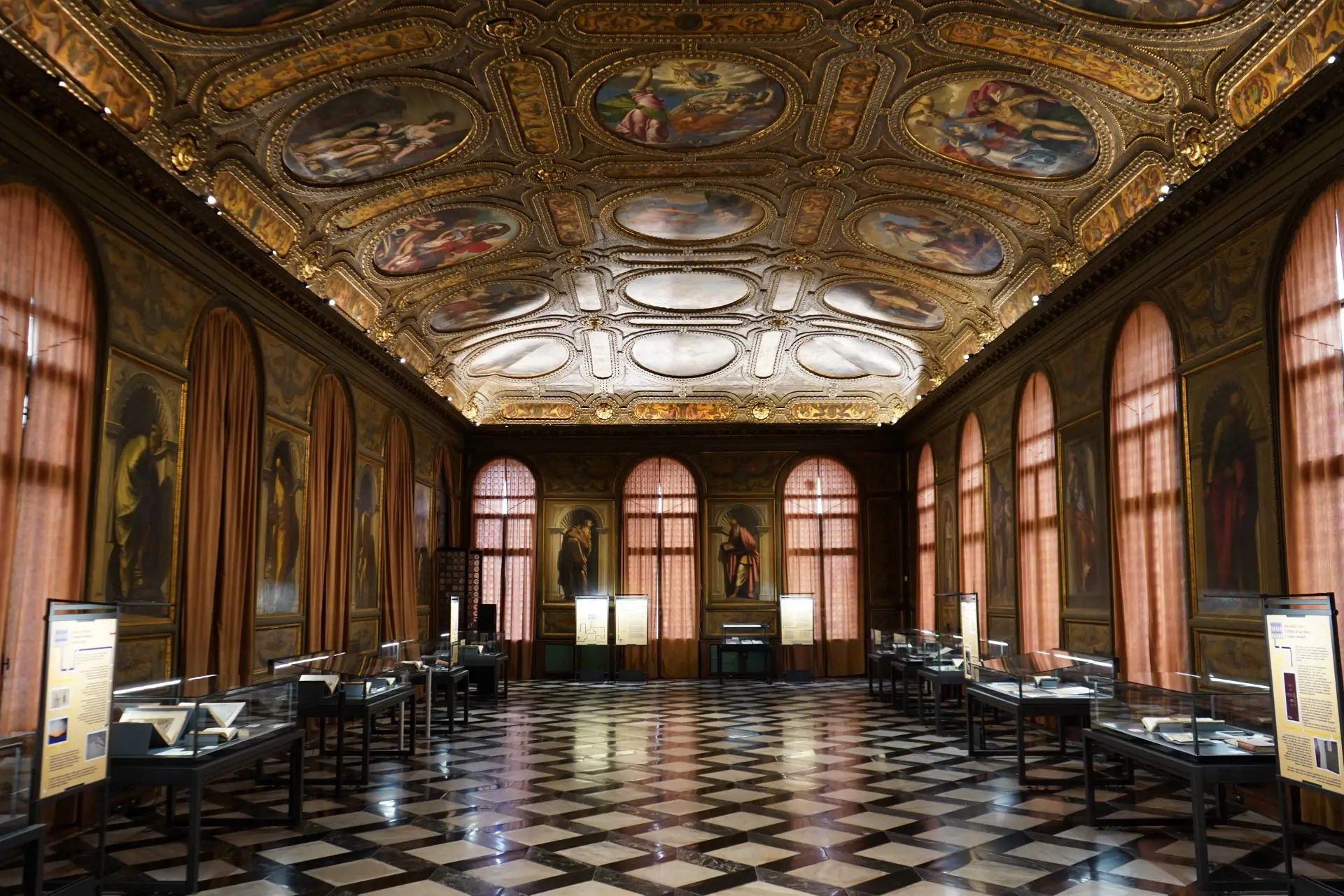
By 1560, the Library of St Mark—under the authority of the Reformers of the University of Padua—was in operation. The great hall was furnished with walnut reading desks, to which the codices were chained, along with cabinets for storing books, and was enriched with a lavish decorative scheme.
The Vestibule was designated as the seat of the Scuola di San Marco and as a venue for academic gatherings.
In 1596, the Public Statuary of the Republic was inaugurated in the adapted Vestibule of the Library to house the donation of Greek and Roman sculptures made by Cardinal Giovanni Grimani, supplemented by further pieces contributed by Federico Contarini.
From that time, the histories of the Library and the Statuary remained closely intertwined until the early twentieth century, when the Archaeological Museum was established as a separate institution.
The Library in the seventeenth and eighteenth centuries
During the seventeenth and eighteenth centuries, the Library steadily expanded, primarily through donations and bequests, as well as through the obligation imposed on printers to deposit a copy of every book published, as required by a Venetian law of 1603—the first such legislation in Italy.
The patrician Librarian, elected by the Reformers of the University of Padua, was assisted by a Custodian—a learned official responsible for reorganising the collections, compiling catalogues, and opening the Library to scholars—with the help of an attendant.
Around 1624, the first catalogue of the Library was published, describing both manuscripts and printed books. By the end of the seventeenth century, the original chained bookcases were replaced by four large reading tables.
At the beginning of the eighteenth century, the Library’s holdings amounted to approximately ten thousand volumes, which from 1722 onwards were provided with an ex libris.
The continued growth of the collections required additional space. In 1725, the Senate granted the use of a room in the Procuratie wing adjacent to the Hall, intended for the storage and consultation of manuscripts.
The Library was also granted an annual allowance for the acquisition of new volumes, which supported, among other initiatives, the printing of catalogues of Greek, Latin, and Italian manuscripts, published in 1740 and 1741.
During the same period, extensive rebinding campaigns were carried out: all codices were provided with leather bindings embossed on the front cover with the Lion of St Mark.
The increase in the number of volumes necessitated the construction of shelving reaching to the ceiling and the transfer of the paintings to the Doge’s Palace.
Towards the end of the century, the Marciana further expanded its collections through the incorporation of parts of monastic libraries, including those of San Giovanni di Verdara in Padua and Santi Giovanni e Paolo in Venice. Manuscripts, printed books, and documentary collections previously held in the offices of Venetian magistracies—among them the Council of Ten and the Senate—were also absorbed into the Library. A further room in the Procuratie was consequently assigned to accommodate the expanded holdings.
Following the first French occupation, after the fall of the Venetian Republic in 1797, the Library was deprived of 203 manuscripts, two printed musical works, and a precious cameo donated by Girolamo Zulian; these were added to the large number of items removed from Venetian monastic libraries and transferred to France.
After the fall of Napoleon, their restitution was secured in 1816. Further, though more limited, requisitions took place during the subsequent Austrian administration; these too were later recovered.
The Library in the Doge’s Palace (1812–1904)
During the nineteenth century, the Library succeeded in obtaining two additional rooms and, in 1801, acquired the celebrated Grimani Breviary, together with a group of codices distinguished by their sumptuous bindings.
With the return of the French in 1806, the Library was further enriched by the incorporation of monastic collections following the suppression of religious institutions. Among these acquisitions was a significant selection from the library of the Observant Dominicans at the Zattere (the Gesuati), which had absorbed the important collection of Apostolo Zeno. From the library of San Michele in Murano came, among other works, Fra’ Mauro’s celebrated World Map.
The Marciana remained in its original seat until 1811, when, by decree of the Kingdom of Italy, it was transferred—together with the Statuary—to the Doge’s Palace.
The Library was assigned the halls of the Maggior Consiglio and the Scrutinio, along with adjacent rooms for the librarian’s office and for storage. The placement of the volumes, however, was constrained by the need to preserve the extensive cycles of paintings covering the walls.
The Sala della Quarantia was converted into a reading room. At that time, the Library’s holdings comprised approximately 50,000 printed works and 4,556 manuscripts.
The rooms of the Library, which had already hosted meetings of the National Assembly of the Provisional Government of the Republic in 1848–49, were again used on 21 and 22 October 1866 as one of the polling stations for the plebiscite that sanctioned the annexation of the Veneto to the Kingdom of Italy.
The Library in the twentieth century
The limited space available in the Doge’s Palace, the continuous growth of the collections, and the deterioration of the premises led the government in 1900 to assign a new headquarters to the Library.
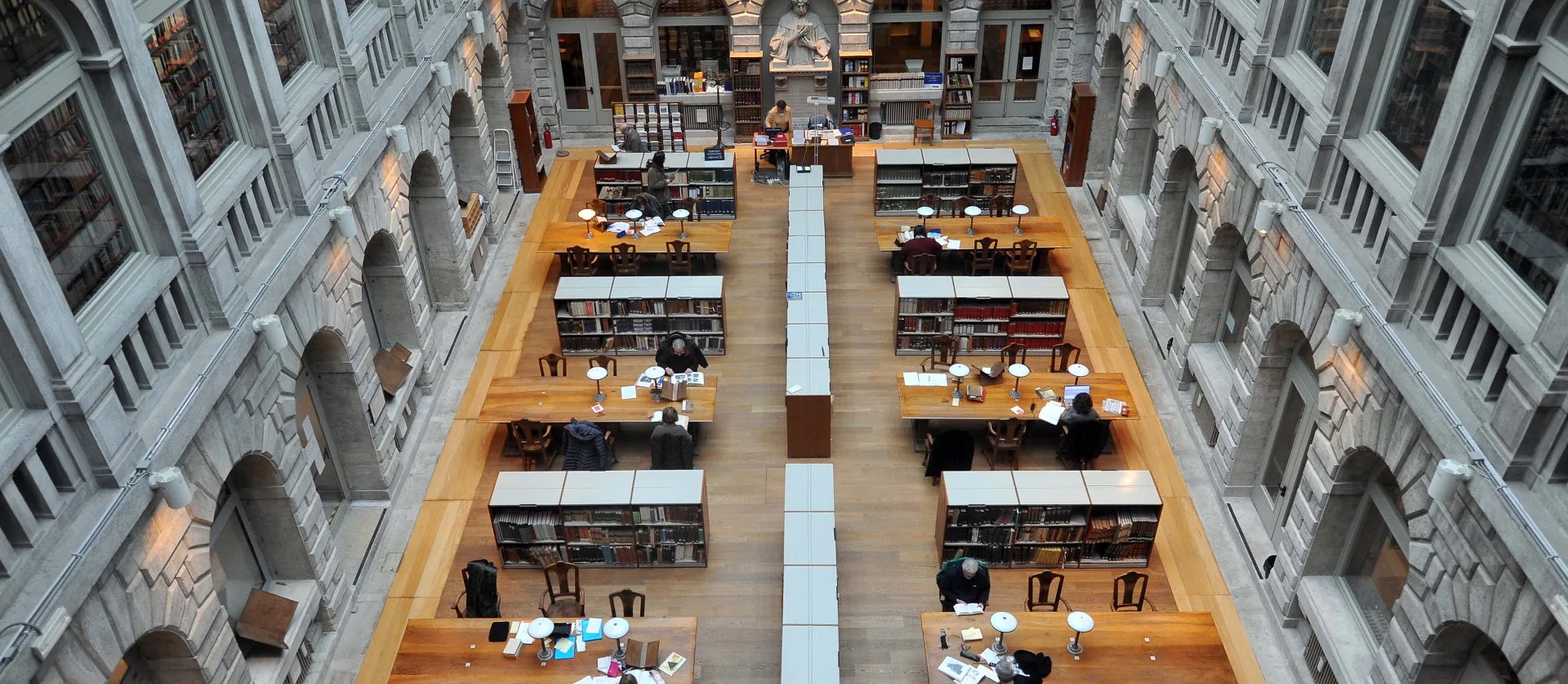
The chosen site was the sixteenth-century building designed by Jacopo Sansovino, formerly the Mint (Zecca) of the Venetian Republic. The courtyard was adapted and roofed over to accommodate the new reading room, furnished with twelve modern reading tables; the monumental puteal was relocated.
The large hall facing the waterfront was designated for the consultation of manuscripts and rare books, while smaller rooms were arranged for the consultation of other categories of material.
The transfer was completed in 1904. During the inauguration ceremony on 27 April 1905, a statue of Francesco Petrarca by the sculptor Carlo Lorenzetti—commissioned by the City of Venice to commemorate the sixth centenary of the poet’s birth—was installed in the reading room.
In 1924, in addition to the Mint, the Marciana regained possession of the Sansovinian Library. After three years of restoration, it was reopened in 1929, and the paintings of the philosophers were repositioned in their original setting.
Today
Since then, the Library has progressively expanded both its public services and its reading facilities, while continuing to use the sixteenth-century Mint building for part of its book storage.
Extensive collections and administrative offices are now housed in the Procuratie Nuove and in the Sansovino Library building. The Vestibule and the Sansovinian Hall are primarily used for exhibitions and cultural events.
Further reading
- Marino Zorzi, La Libreria di San Marco. Libri, lettori, società nella Venezia dei Dogi, Milan, Mondadori, 1987.
- Biblioteca Marciana. Venezia, edited by Marino Zorzi, Florence, Nardini, 1988.
- La Biblioteca Marciana nella nuova sede: 27 aprile 1905, Venice, Biblioteca Nazionale Marciana, 1906.